ali cat portfolio
united states
Ali Cat (she/they) is a Portland, Oregon based self-employed artist. As a printmaker, they are proficient in screen-printing, relief printing, and letterpress. Ali also makes zines, often hand-bound (i.e., sewn); her relationship with needle and thread continues to deepen through making needlelace, teaching others, and developing a multidisciplinary lace-based project, “Entangled Roots Lace.”
As impacts of the COVID-19 pandemic were unfolding worldwide, at the age of thirty-two Ali was invited by a dear friend of hers to participate in an online janyak (“lace” in Eastern Armenian) class taught by Emma Welty, through the group Armenian Creatives. Ali’s continued learning was aided by Alice Odian Kasparian's book, Armenian Needlelace and Embroidery, which gave much guidance on their learning journey, as is the case with several other diasporic makers featured on this site (e.g., Welty, Mikayla Kurkjian, and Elise Youssoufian).
Interestingly, before learning to make needlelace, Ali had never done any Armenian needlework. The needlelace is difficult to make; initially, they excused their inability to take to it naturally by reasoning that it was not in their lineage—or so they thought. It was not until more than a year later, when a Palestinian friend invited Ali to co-host a monthly SWANA (Southwest Asian and North African) stitching circle that she picked it up again. Through this circle, she committed to the craft; around that same time, her mother gifted Ali some of her great-grandmother's lacework.
As is the story for many Armenians living in diaspora, very few heirlooms were able to be saved when Ali’s family fled from ancestral places. With maternal roots in Bitlis, a historically significant city in the Armenian kingdom of Van (present-day southeastern Turkey), Ali was born in 1988, in the wine country of Napa Valley in California. Her birthplace is just a few hours north of the agricultural center of Fresno where her great-grandparents settled after escaping violent waves of ethnic cleansing in Western Armenia in the late nineteenth and early twentieth centuries.
In the Napa Valley, Ali did not grow up in an Armenian community, and the language was not passed to them. While Armenian food and coffee always had a place at the table, other folk practices were lost. Though Ali’s great-grandmother, Nuvart, made needlelace and crocheted lace, Ali is the only one in their family who has learned to make lace in her generation. While there is general appreciation of tradition in the family, there does not seem to be much interest in the needlelace from their young relations.
For Ali, the lace serves as a reclaiming of a cultural practice and a remembering of an art form that was intimately part of our ancestors’ lives. She notes that the lace, “originally part of every home,” was “turned into a commodity” and is “now a thread in our collective remembrance.”
They have taught one needlelace workshop in person and will probably do so again. They have also taught many folks one-on-one at Portland’s SWANA Stitch circle, a monthly space for practicing ancestral craft and building SWANA community and solidarity. Meeting monthly for over three years, SWANA Stitch has fostered friendships, creative projects, mutual aid, ancestral reclamation, skill-shares, and lots of laughter. About the circle, Ali affirms: “We are open to all skill levels—whether you’re a master crafter or have never stitched before. Our space is for the folks who come to it and stitch together.”
website
instagram
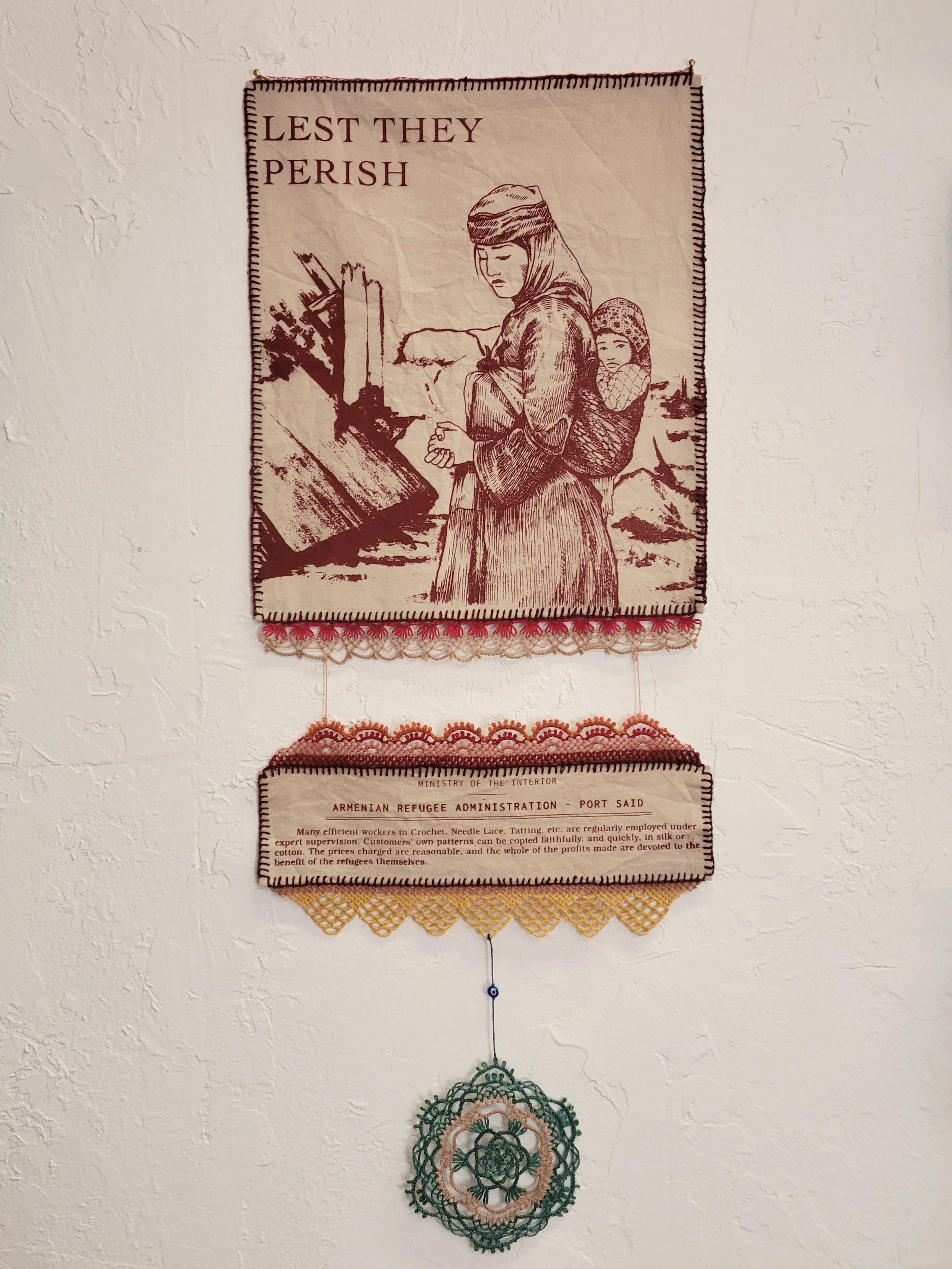
Ali Cat, Lest They Parish, screenprint on fabric with lace trim; sumac-dyed muslin, cotton and linen thread, screen printing ink and Areni wine, Portland, Oregon, 2024. Dedicated to the victims and survivors of the Armenian genocide—a central reason many of us never learned our cultural crafts including janyak, and simultaneously the reason for its preservation. The illustration is a recreation of one of many propaganda posters created during that time, a plea to save the Armenian people from annihilation. The text comes from another poster advertising the work offered by refugees of the time. Below the text were samples to choose from. The lace edging are samples of janyak highlighting different traditional land-based patterns: the ubiquitous Mt. Ararat, sunrise, our circle dance, and regions of now occupied lands. This piece was part of the annual SWANA Stitch show, "Threadlines," held at SWANA Rose Cultural + Community Center during textile month in Portland, Oregon. Photo credit: © Ali Cat 2024.
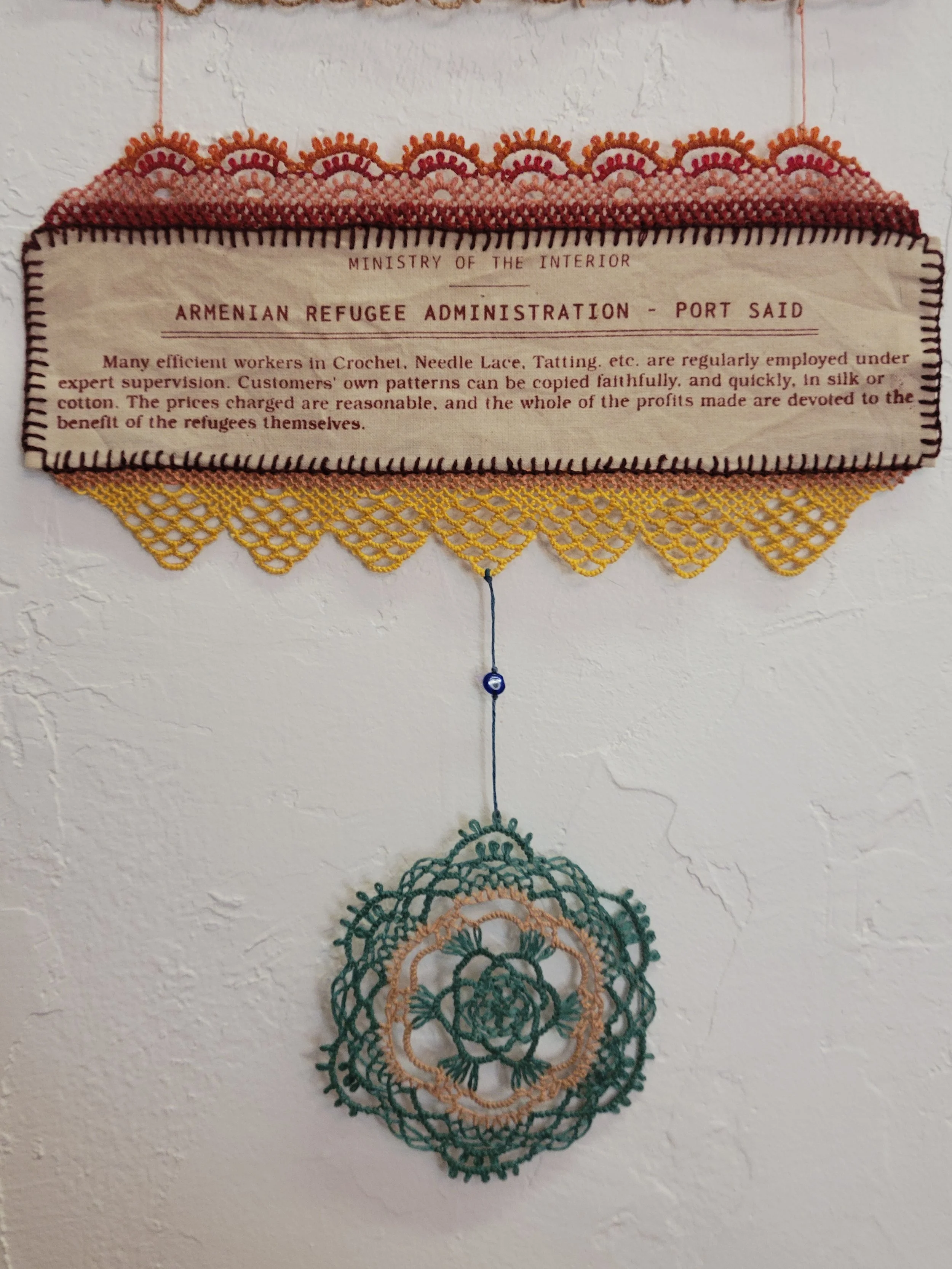
Ali Cat, Lest They Parish, screenprint on fabric with lace trim (detail), Portland, Oregon, 2024. Photo credit: © Ali Cat 2024.
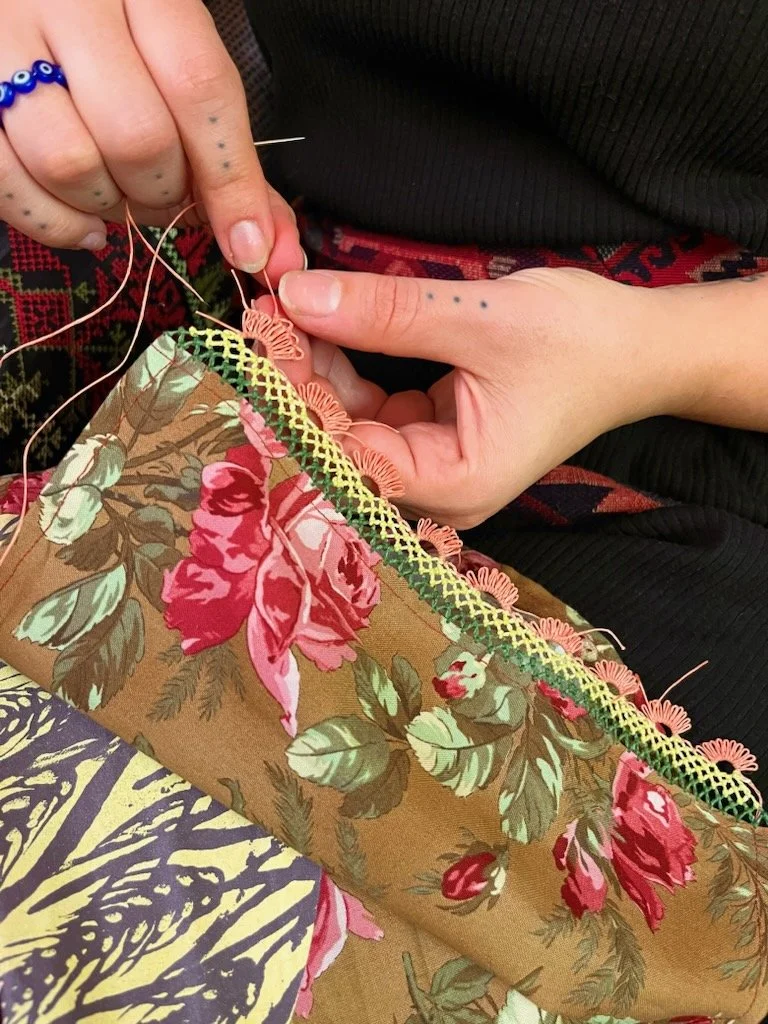
Ali Cat, janyak border-in-process, linen thread on cotton fabric, Portland, Oregon, 2025. Janyak border added to a screenprinted banner at the March 2025 SWANA Stitch gathering at SWANA Rose Culture + Community Center. Photo credit: © Veera Suliman 2025.
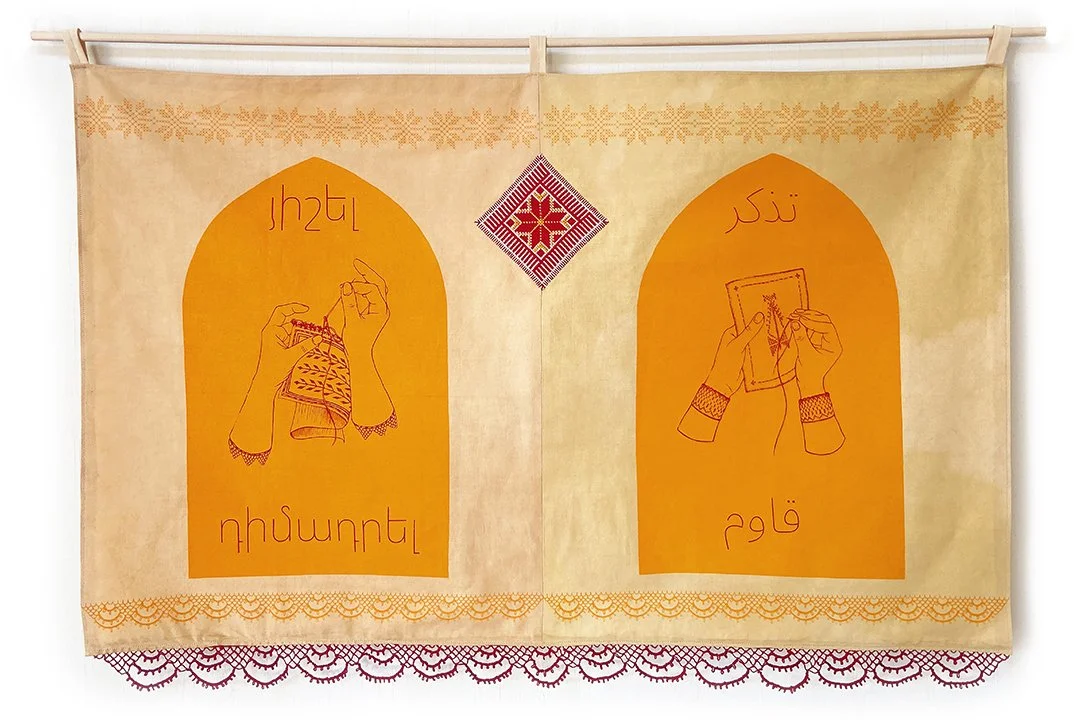
Ali Cat, Remember / Resist (Armenian: յիշել / դիմադրել | Arabic: تذكر / قاوم), natural dyed cotton tapestry, with screen printing, Palestinian tatreez and Armenian janyak; cotton fabric, cotton and linen thread, Portland, Oregon, 2023. Made in collaboration with Palestinian artist Bint Bandora. At the time of making they had both been diving into the remembrance of their respective ancestral crafts: "to remember through study, research, and building relationships with others practicing these heirloom, but still evolving, crafts. To resist by reclamation, education and weaving together our shared struggles for dignity, joy and beauty in the face of ethnic cleansing, appropriation, and erasure." Photo credit: © Ali Cat 2023.
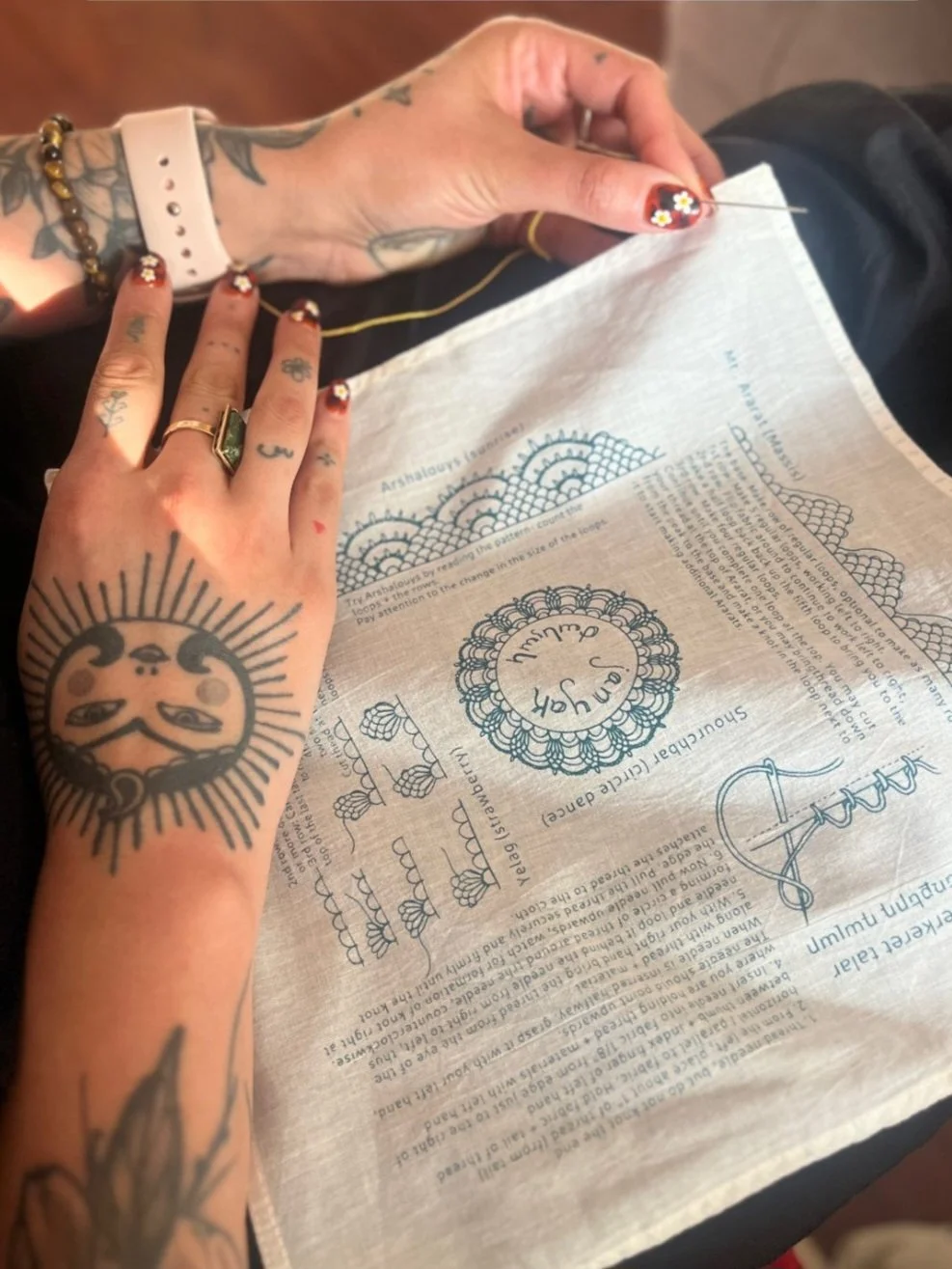
Ali Cat, screenprint on handkerchief, cotton fabric and linen thread, Portland, Oregon, 2025. Ali created the illustration and text to be used as an aid for their first janyak class, "Intro to Janyak," as part of the SWANA Stitch Workshop series at SWANA Rose in April 2025, combining instructions with a physical piece for students to practice adding a lace trim to. Image includes hands of participant, Sahar Y., an Iranian SWANA Rose community member. Photo credit: © Veera Suliman 2025.
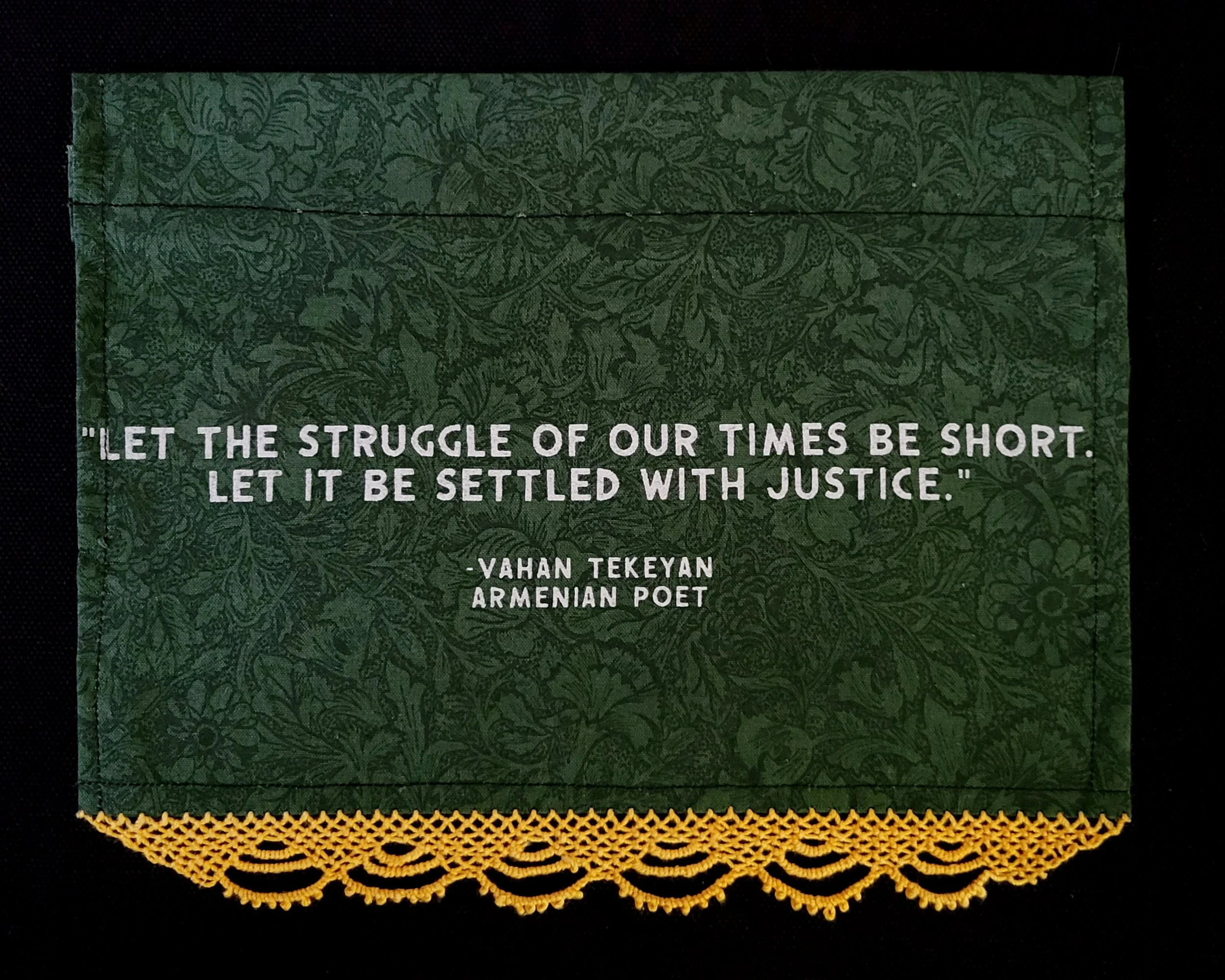
Ali Cat, screenprint with lace trim, cotton fabric and linen thread, Portland, Oregon, 2024. Features a line from Armenian poet Vahan Tekeyan: "Let the struggle of our times be short. Let it be settled with justice." Photo credit: © Ali Cat 2024.
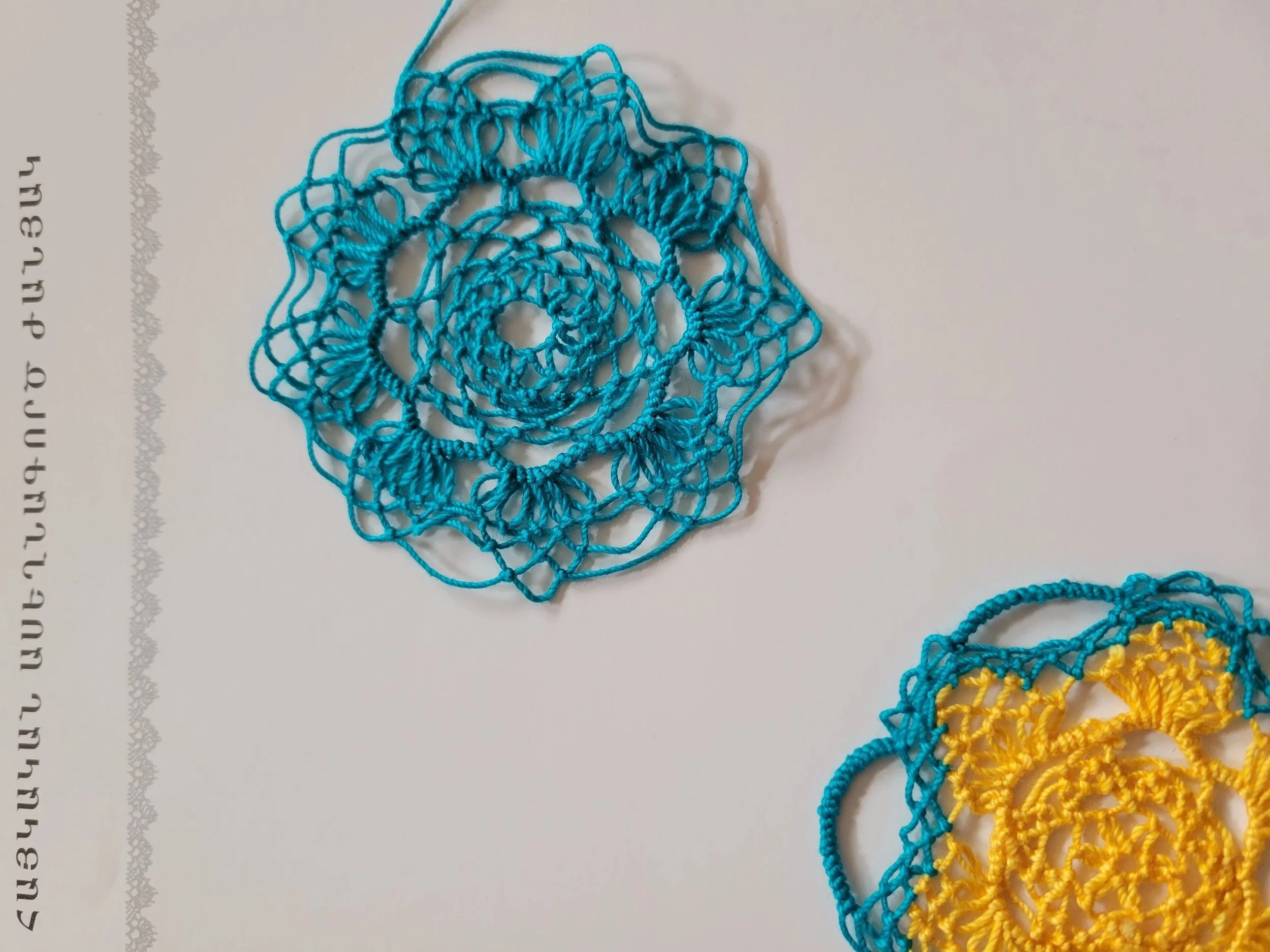
Ali Cat, small practice doilies paired with a page from Lusine Mkhitaryan's instructional text, Հայկական Ասեղնագործ Ժանյակ (Armenian Needle Lace), cotton thread, Portland, Oregon, 2024. Photo credit: © Ali Cat 2024.
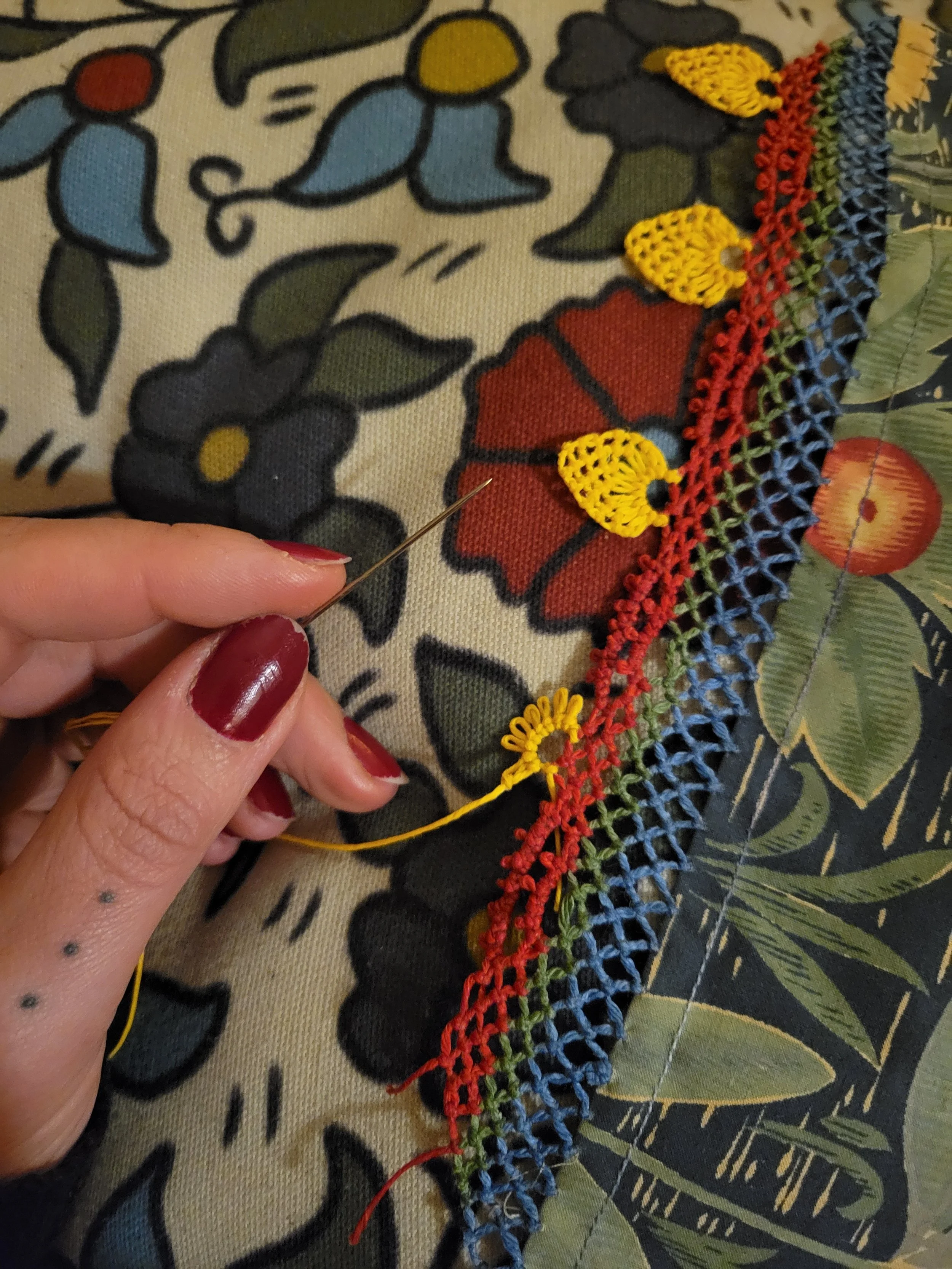
Ali Cat, screenprinted banner with janyak border-in-process, cotton and linen thread, Portland, Oregon, 2024. Photo credit: © Ali Cat 2024.
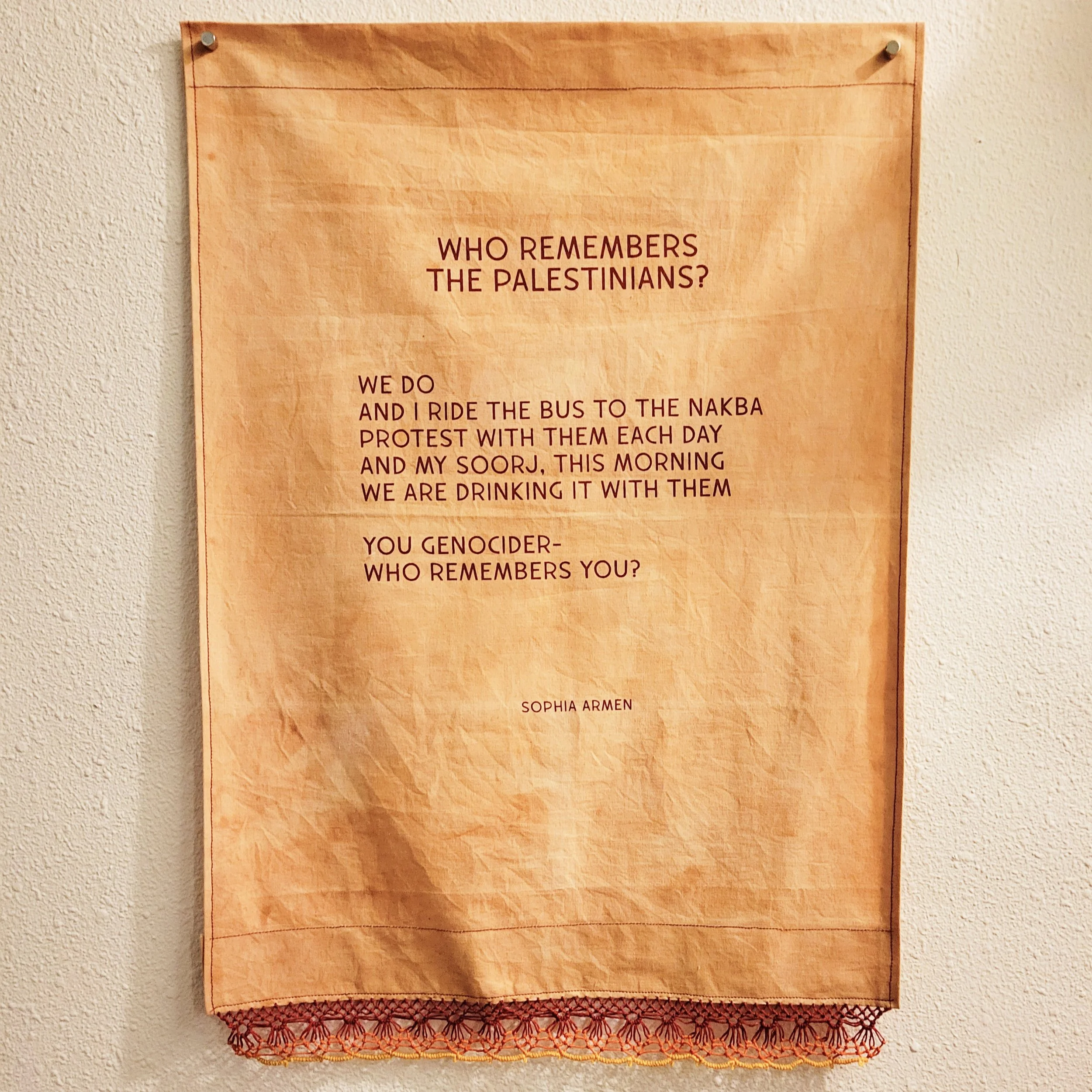
Ali Cat, Who Remembers, screenprint on fabric with lace trim, cotton and linen thread, Portland, Oregon, 2023. The first SWANA Stitch community show was held just two weeks after the start of the current genocide in Palestine and just three weeks after the total ethnic cleansing of Armenians from Artsakh. "From the medz yeghern to the nakba, to the atrocities of today, we will not forget." As Ali's co-organizer says, "we keep the records," in every stitch and in every story passed down. The motif stitched at the bottom of the banners is called shourchpar (Armenian circle dance). For communal circle dances dabke (Palestinian) and shourchpar, the people stand shoulder to shoulder. Here, Sophia Armen's poem, "Who Remembers the Palestinians?" was a response to Palestinian poet Najwan Darwish, whose poem (see related image) is a response to Hitler's question used to justify his actions: "Who now remembers the Armenians?" Shown in "Sewn Threads, Cut Threads: An Exhibition by Portland SWANA Stitch" as part of Portland Textile Month, October 2023. Photo credit: © Ali Cat 2023.
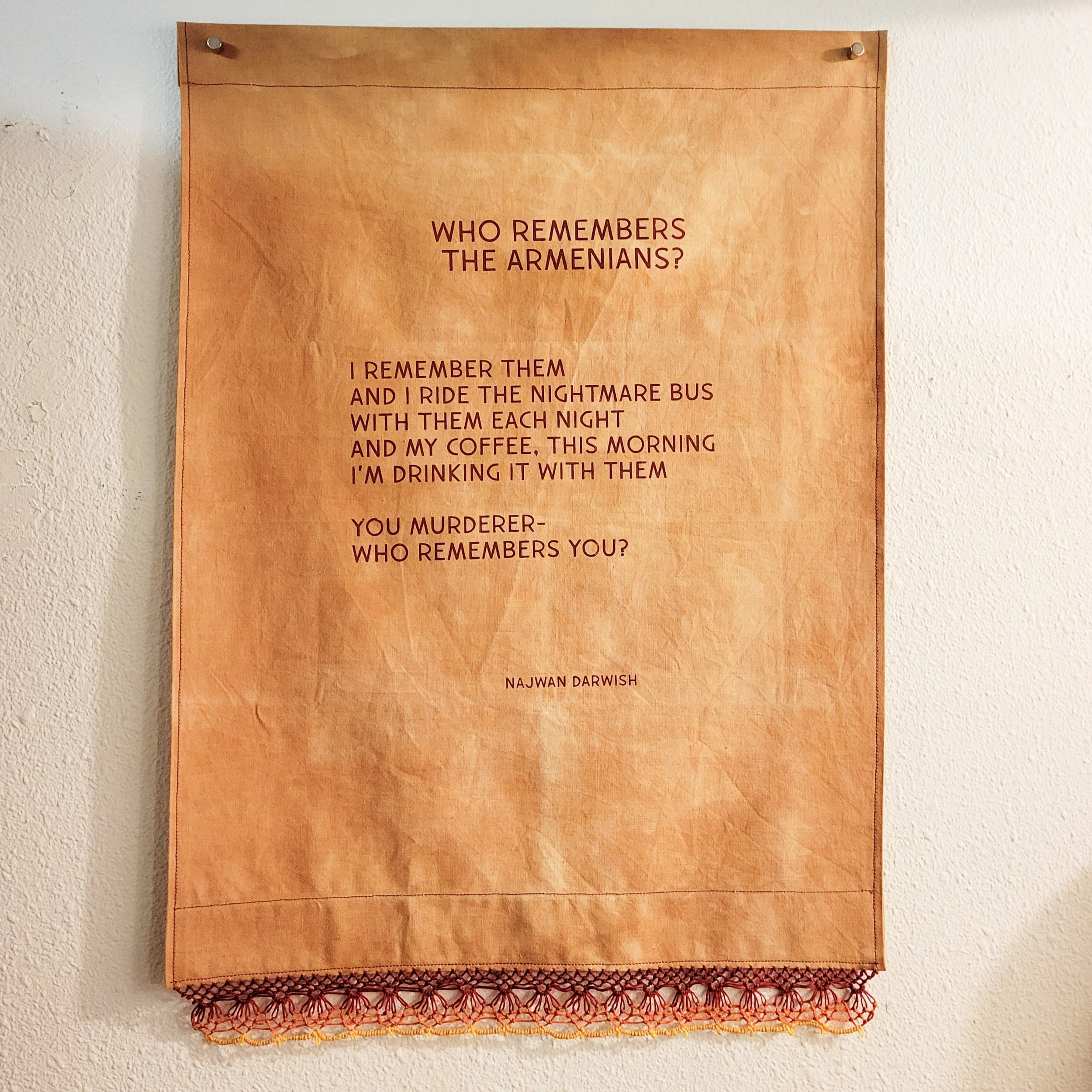
Ali Cat, Who Remembers, screenprint on fabric with lace trim, cotton and linen thread, Portland, Oregon, 2023. Here, Palestinian poet Najwan Darwish asks, "Who Remembers the Armenians"—which inspired Sophia Armen's poem (see related image)—is a response to Hitler's question used to justify his actions: "Who now remembers the Armenians?" Shown in "Sewn Threads, Cut Threads: An Exhibition by Portland SWANA Stitch" as part of Portland Textile Month, October 2023. Photo credit: © Ali Cat 2023.
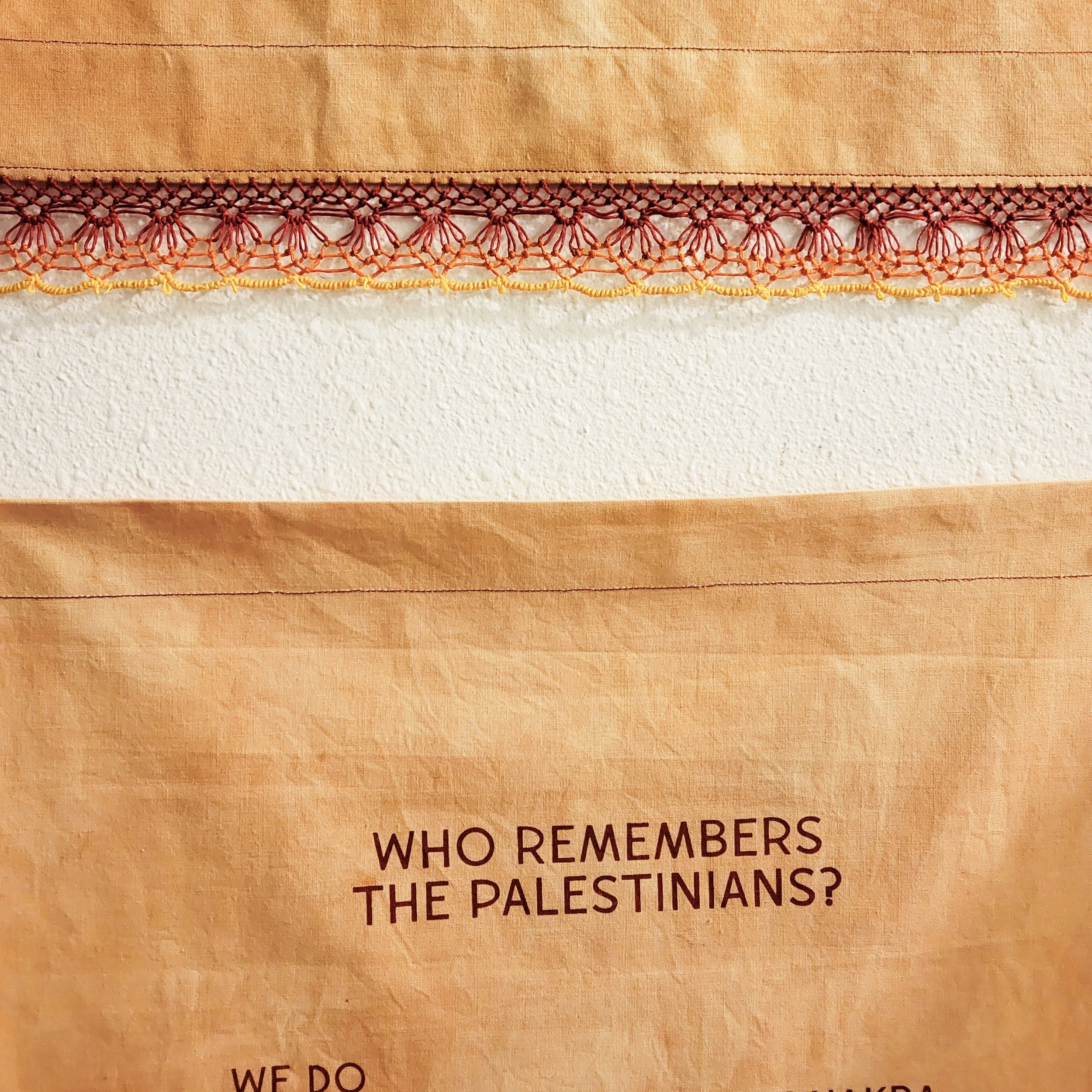
Ali Cat, Who Remembers, screenprint on fabric with lace trim (detail), Portland, Oregon, 2023. Photo credit: © Ali Cat 2023.