elise youssoufian portfolio
united states
Since childhood, Elise Youssoufian (she/they) has been creating through word, song, and thread. Today, together with her poetry and music practice, she makes and teaches Armenian needlelace traditions in their home and wherever they roam.
For decades, Elise had longed to reclaim ancestral needlework forms displayed in relatives’ homes in Tongva and Chumash lands (Southern California). As a child in the 1980s, seeing the laceworks as well as images of khachkar (cross-stones) in Armenian history books, she would run her fingers along their mysterious, interlacing patterns. But being the offspring of orphaned immigrants to the US, she thought there was no one left in the family who could teach her to make the lace. Later, as an adult based in the San Francisco Bay Area with few Armenian friends, she did not know where or how to begin. Around 2016, when Elise’s parents entrusted her with the few handwork heirlooms the family had been able to save, a pathway home was beginning to form, though she did not yet know it.
Everything changed in 2019 when Elise climbed her matrilineal mountain, Musaler (a.k.a., Musa Dagh in Turkish), and worked with the Teryan Cultural Center in Yerevan, where her Armenian Volunteer Corps service took the form of dedicated learning. Thanks to the immense skill and generosity of teachers Iskuhi Sargsyan, Lusine Mkhitaryan, and others, Elise began making needlelace and building community.
From that time through today, guided by instructional texts and ancestral intuition, Elise continues to grow their needlelace skills, specializing in tiny, intricate designs and bolstered by meeting other makers in ancestral lands and in diaspora. Conversations with her beloved gunkamayr (godmother), Aroussiac Bedrosian—whose love of needlework, especially lace, she passed down to Elise—provided much encouragement, and in the wake of Aroussiac’s passing in 2024 at the age of 93, her daughters gave her collected laceworks to Elise. Throughout it all, the making accompanies Elise amid personal and collective upheavals, and during long journeys, meetings, protests, doctor’s visits, and bus rides home. An intentional practice in times of grief and praise, her needlelace often features mountains and sunrise patterns—holding tales of travels, struggles, seasons, and hopes.
After teaching several sold-out workshops in Armenia and the United States from 2021 to 2025, Elise now holds the Tserakordz Circle, an in-person class for beginning and continuing students to grow their needlelace skills, share stories, and build community. Teaching the tradition has become a small source of income, but Elise does not sell her needlelace works. Rather, the tradition serves as support of another kind. They gift needlelace medallions to kindred spirits and donate them along with a portion of class fees to raise funds for critically needed humanitarian aid. Harnessing the power of the sun, Elise is developing a series of fabric cyanotype prints that center her poems with needlelace gracing the margins, integrating ancestral threads with her own creations. Calling upon the intellect and fortitude of their foremothers, they make needlelace to nourish and be nourished by their roots, and cultivate calm and creativity in troubling times—helping them envision brighter, healing futures. As Elise shares, “The needlelace makes me come alive, a gift I will reciprocate, always.”
Elise is a co-founder of the Armenian Needlelace Initiative.
website
instagram
professional bio
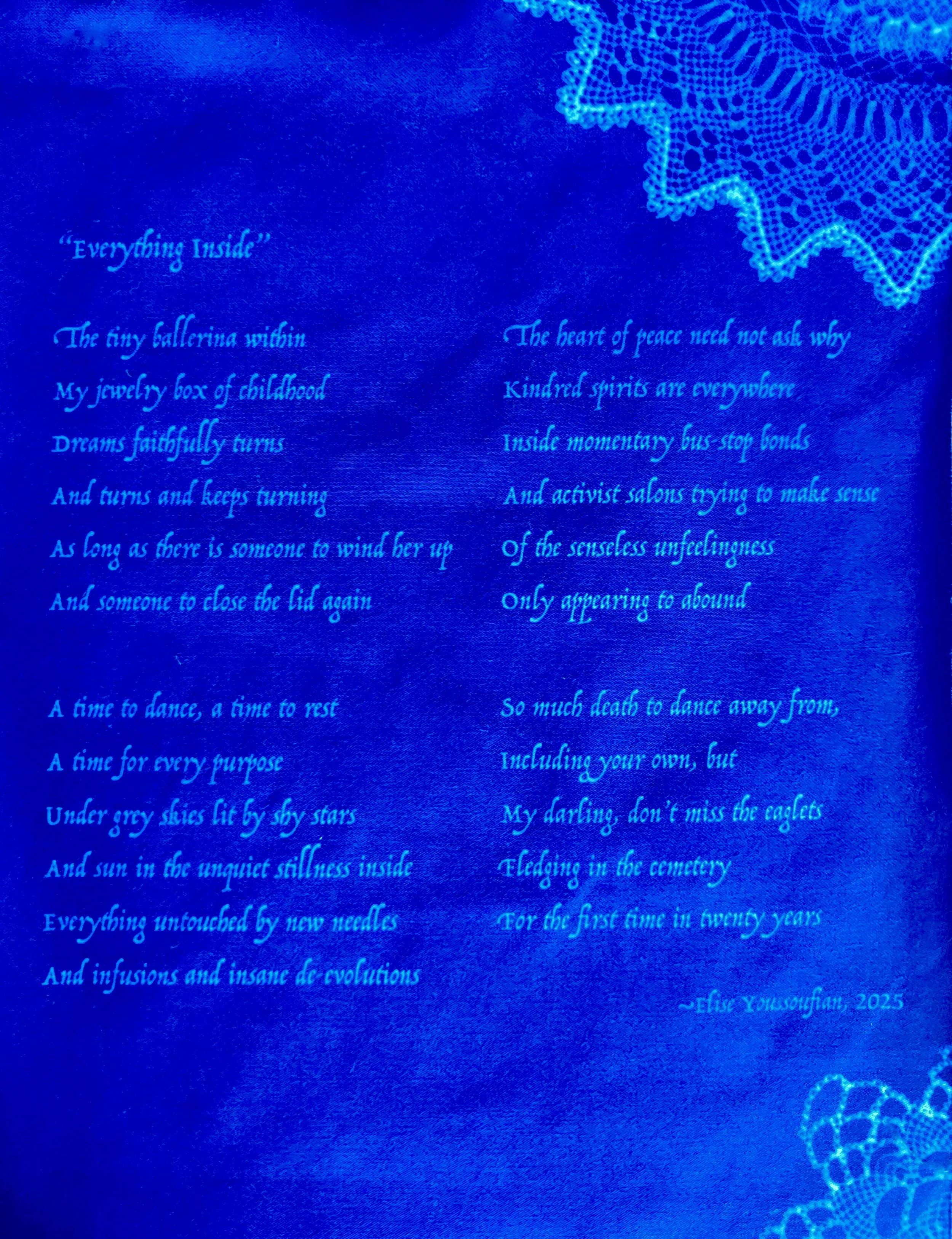
Elise Youssoufian, Everything Inside, 2025. Cyanotype on cotton fabric, one of three in a series weaving ancestral works with Elise's own poetry and needlelace creations, UCSF Art for Recovery SFMOMA Gallery (San Francisco, 2025–2026). Photo credit: © Elise Youssoufian 2025.
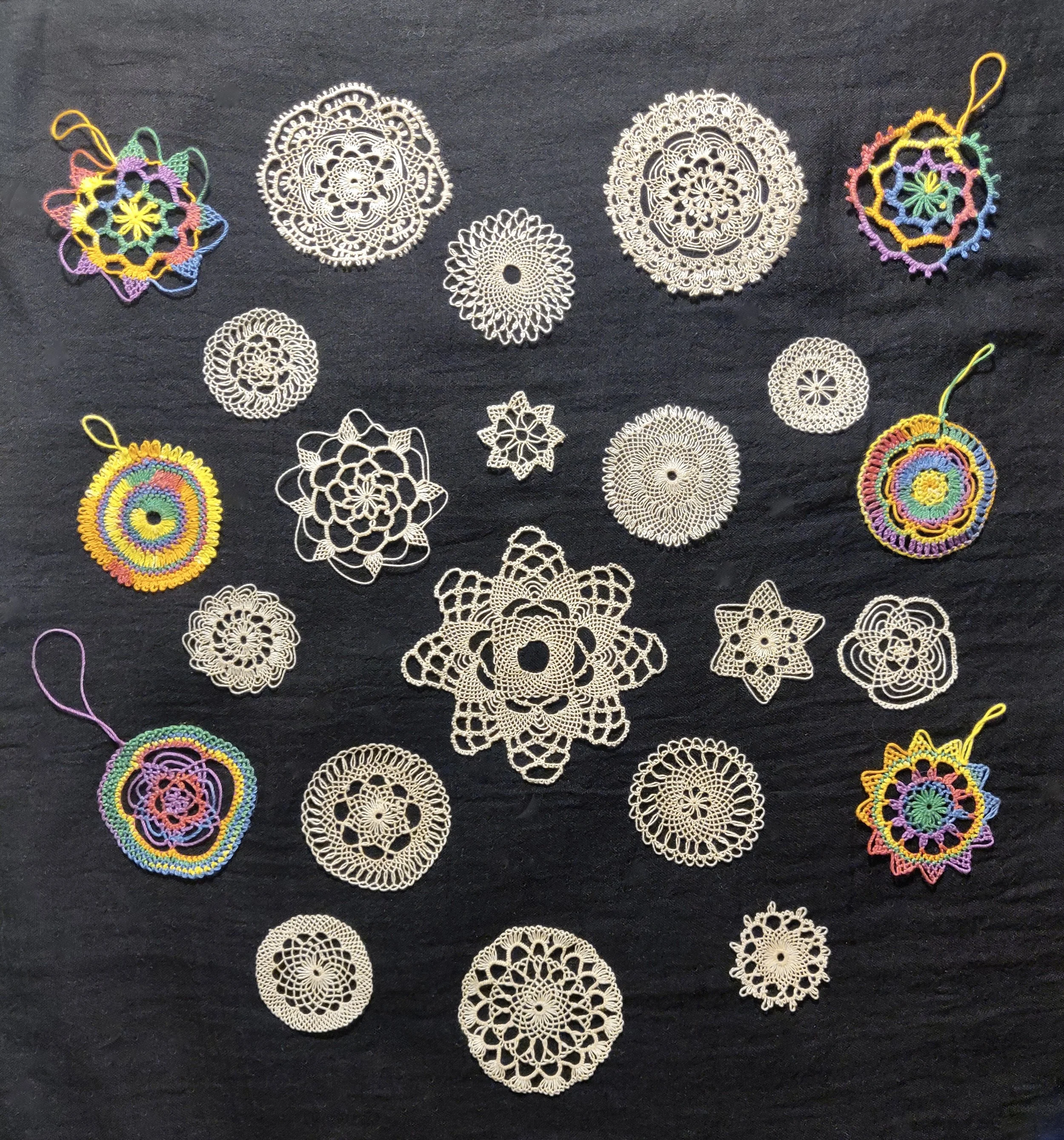
Elise Youssoufian, 2020. Assorted needlelace ornaments and medallions, one inch to four inches in diameter. During the fall 2020 war in Artsakh (a.k.a., Nagorno-Karabakh), the rainbow-hued ornaments were among dozens made to support humanitarian aid for indigenous Armenians enduring violent dispossession, death, and destruction. The ecru medallions, made before the war, were based upon tiny works made by children orphaned in the Armenian Genocide (1915–1923) who were taught the art as a means of survival. Photo credit: © Elise Youssoufian 2020.
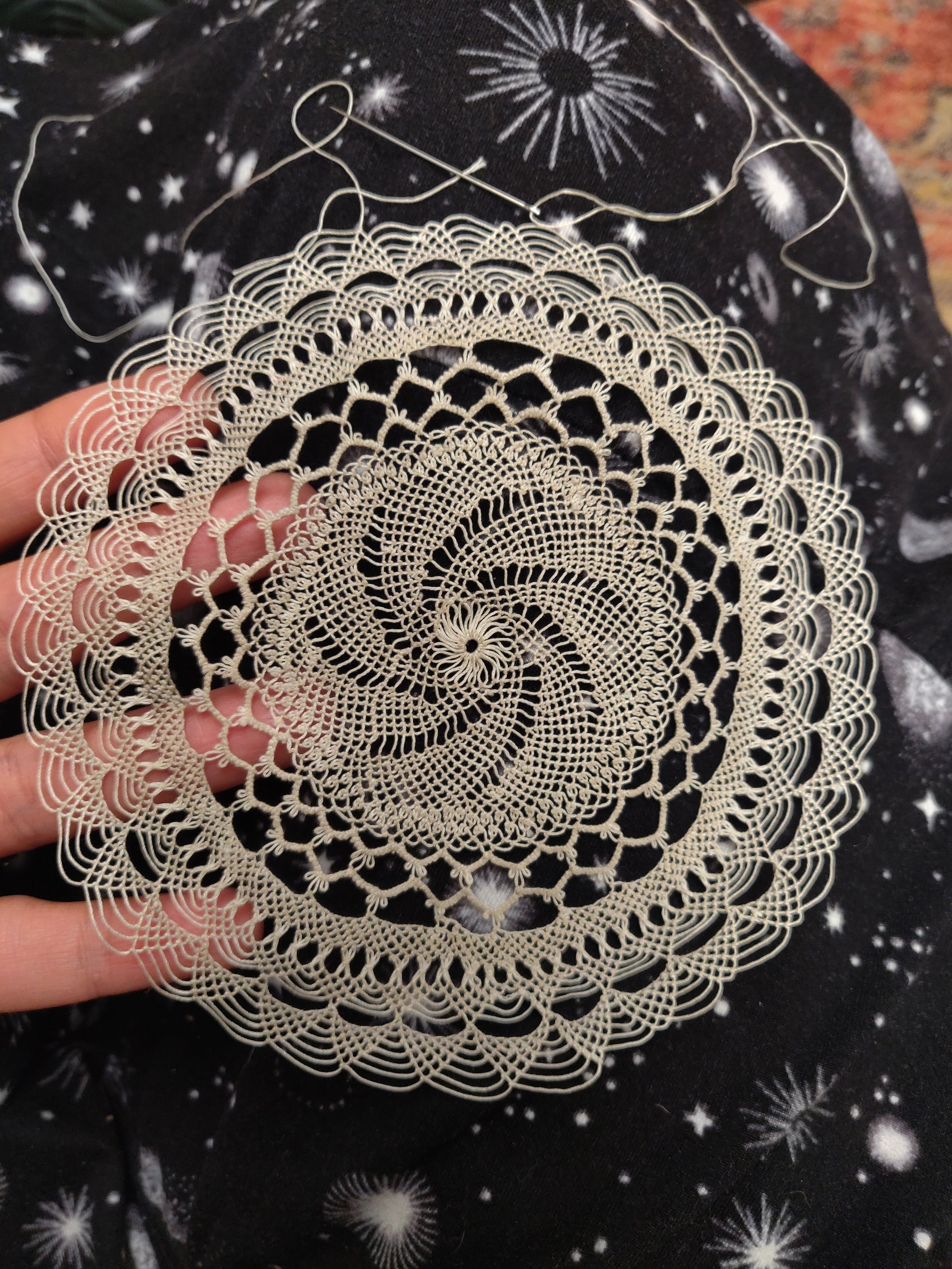
Elise Youssoufian, Cosmos, 2025. Armenian needlelace doily-in-process. With a symbol of eternity and Elise's matrilineal lands holding its center, this piece began during the traditional Blessing of the Grapes in the Armenian village of Vakıflı, in Musaler (a.k.a., Musa Dagh), in present-day Turkey, near the Syrian border and the Mediterranean Sea. On journeys from there through historic Armenia all the way to Lake Van, and back to the San Francisco Bay Area, this work-in-progress continues growing with mountains and rainbows rising. Photo credit: © Elise Youssoufian 2025.
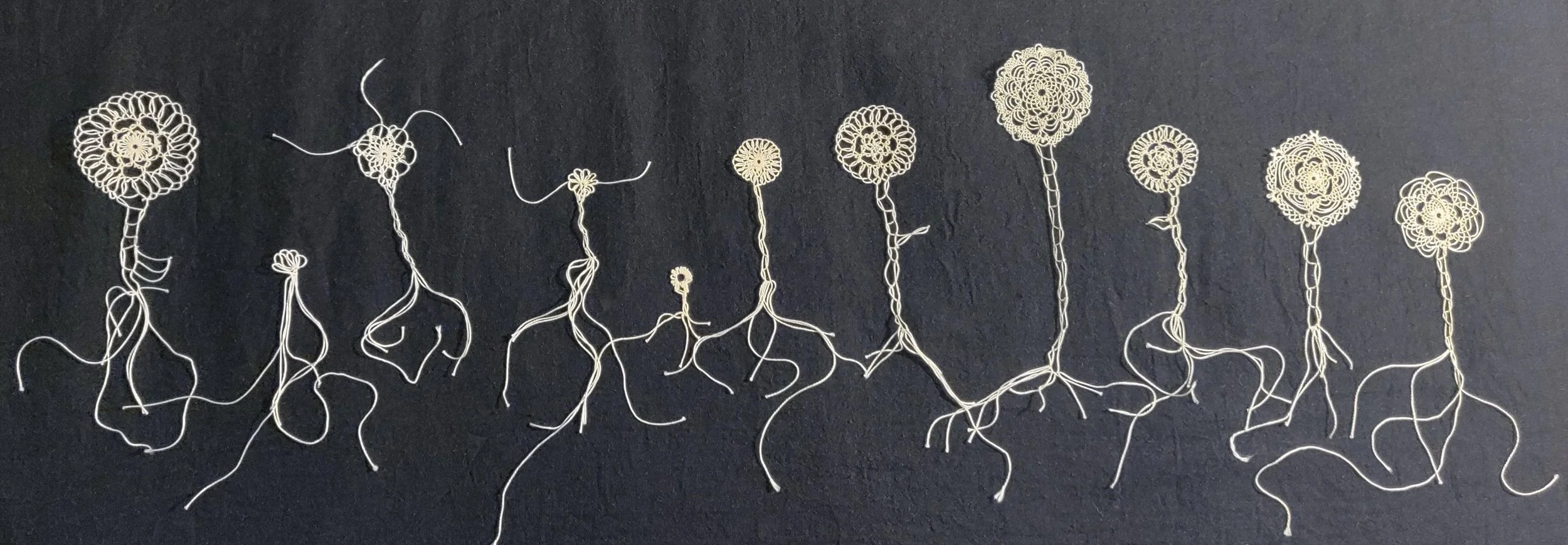
Elise Youssoufian, Ancestors, 2020. Armenian needlelace works. These creations served as a source of spiritual support and comfort during the early days of COVID-19 chaos and isolation. Photo credit: © Elise Youssoufian 2020.
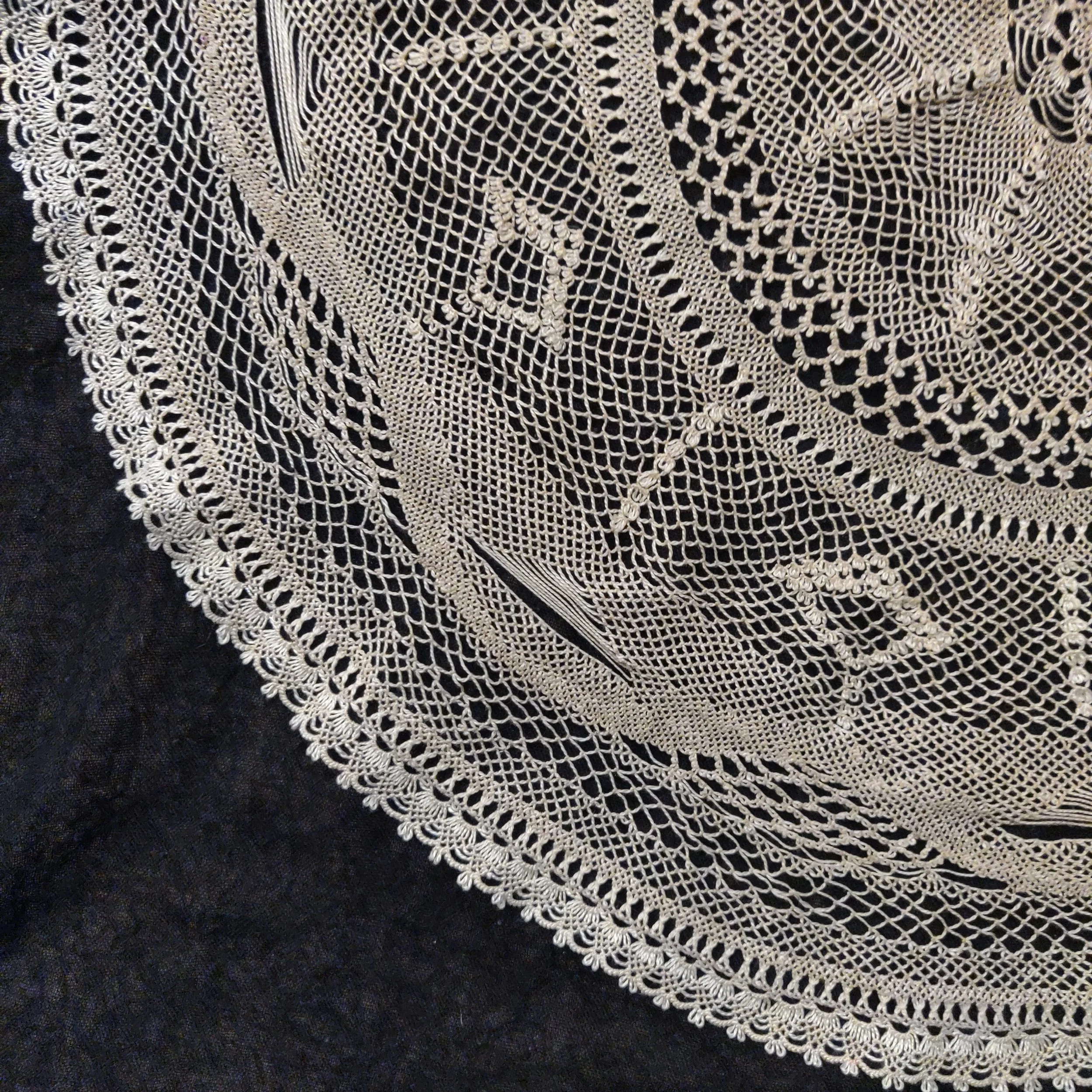
Elise Youssoufian, Seven Months, 2020-2021. Large needlelace doily. To help Elise stay present amid chaotic intersections of COVID-19, war, and uprisings against injustice, Elise experimented with her then-budding needlelace skills, bringing together traditional patterns and improvised designs, to complete this piece just in time to travel back to Armenia for an artist residency. For safe keeping, Elise gave this work to her sister in the United States soon before the journey. Photo credit: © Elise Youssoufian 2021.