elise youssoufian
Էլիզ Եուսուֆեան
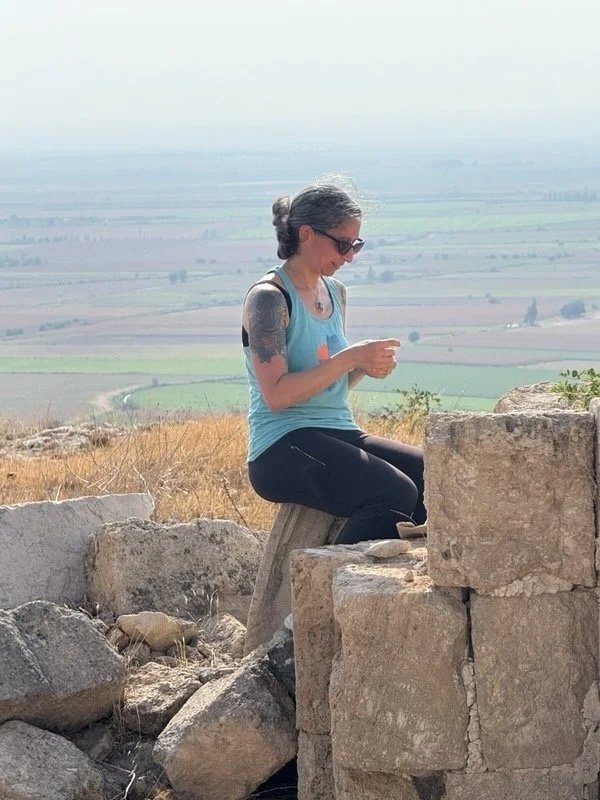
Elise Youssoufian making needlelace amid the ruins of a twelfth-century Armenian church, Anavarza Castle, Adana Province, Türkiye, 2025. Photo credit: © Georgi Anahid Bargamian 2025.
Armenian Needlelace Initiative co-founder Elise Youssoufian (she/they) is a Los Angeles born, San Francisco Bay Area based Armenian poet, transdisciplinary artist, and practitioner-scholar committed to healing and liberation. With faith and hope in Earth-honoring, alchemical acts of creativity and connection, Elise has been teaching in the arts since 2009 and offering Armenian needlelace classes and workshops in the US and Armenia since 2021. Hand-in-hand with projects rooted in compassion, cultural recovery, and collective healing, she is also a board-certified therapeutic musician and treasures her practice of aikido, a Japanese martial art of peace.
Walking with Zabel Yessayan’s life-affirming inquiry, “how does beauty resist?” and driven to inhabit and invigorate patterns of their foremothers, Elise is developing a PhD dissertation in the field of Women’s Spirituality on Armenian needlelace and relationships between handwork, healing, and resistance. Back in 2018, Elise began becoming literate in their first language, Western Armenian, en route to ancestral journeys throughout Türkiye and Armenia in 2019. Through volunteering at Yerevan’s Teryan Cultural Center, she started learning to make needlelace and Marash embroidery, and has refined her Armenian needlework practices on her own ever since. In 2021, Elise journeyed back to Armenia for an artist residency and stayed through 2022, climbing mountains and studying carpet-weaving traditions, drawing upon past experience restoring antique SWANA (Southwest Asian and North African) rugs. After returning to the Lisjan (Ohlone) territory of Huchiun (Oakland, California) to address a cancer diagnosis, they co-facilitated field work in Istanbul and curated a nearly year-long museum exhibition, Armenian Needlelace: Poetry in Thread. Currently cancer-free, Elise recently traveled through historic Armenia with the National Association for Armenian Studies and Research and now serves as an Armenian needlework consultant for her local chapter of Hamazkayin, a global Armenian educational and cultural organization.
Elise Youssoufian making needlelace near mineral-rich sulfur hot springs long-renowned for their healing qualities, just north of the border with Armenia, Leghvtakhevi Waterfall, Tbilisi, Georgia, 2021. Video credit: © Elise Youssoufian 2021.
Elise earned a Master of Fine Arts degree in Interdisciplinary Arts and Writing from the California Institute of Integral Studies, studied folklore and psychology at UC Berkeley, and participated in artist residencies in Chiapas and Yerevan. In the wake of the 2020 war in Artsakh (a.k.a., Nagorno-Karabakh), while in Armenia they launched an arts activism initiative, Sound of Ten Thousand Stones, participated in the International Armenian Literary Alliance’s inaugural mentorship program, and reflected on wounding and healing for the Armenian Weekly column, “Walking and Asking.” Other works include poems in International Gallerie, Fools Fables, HyeBred Magazine, Armenian Poetry Project, and Kooyrigs’ forthcoming Looys: Voices of Resistance in Verse.
family
Repair and restoration guide Elise onward as she explores the burdens and blessings of her lineages. On farms and vineyards in Cilicia and historic Armenia (present-day eastern Türkiye), her foremothers made lace and worked the land, weaving patterns of language, story and place until disruptions loomed. Elise’s motherline stems from her grand-grandmother Ovsanna, of Bitias—one of six Armenian villages which persisted until 1915 in Musa Dagh, a mountainous region known for its beauty and its peoples’ resistance to annihilation during the Armenian Genocide (1915-1923). Another great-grandmother, Mayreni of Antep, survived death marches through the deserts of Der Zor with two of her seven children, one of whom became Elise’s maternal grandfather. A third great-grandmother, Kohar Elise of Konya, brought Elise’s paternal grandfather into this world but died soon before the birth of her first grandchild, who became Elise’s father. Her fourth great-grandmother, Arousiag of Smyrna, endured the death of her husband—who had been murdered like many other Armenian priests—and found refuge in Egypt with their five daughters, the youngest of whom became Elise’s paternal grandmother, Alice. Though Elise did not grow up with her grandparents—her mother was orphaned young in Beirut, her father, permanently separated from his parents as a child—the presence of her ancestors burns brightly.
As the grandchild of displaced genocide survivors and offspring of orphaned immigrants, Elise is fueled by solidarity with all who struggle for the right to exist in peace and by the belief a healing world is possible. In support of crucially needed humanitarian aid, she helps raise funds for Kooyrigs, Middle East Children’s Alliance, and others. To learn more about their motivations, see “A Granddaughter of Genocide Survivors Dreams of Never Again” by Dana Mashoian Walrath, an award-winning author, artist, and anthropologist.
website
instagram
maker’s bio
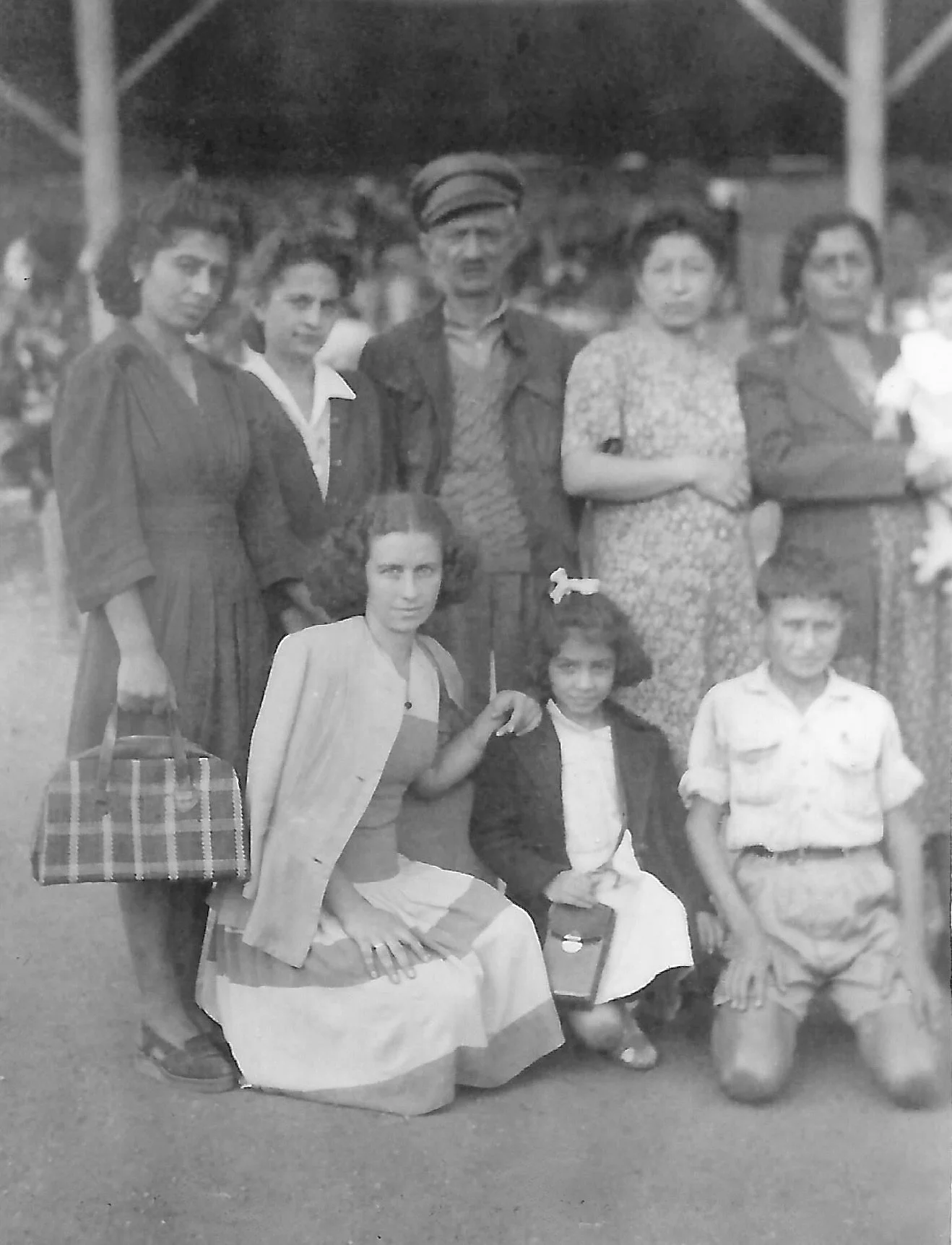
Elise Youssoufian’s great-grandmother Ovsanna Dedeian (née Chaparian, far right, holding Elise’s then-infant mother) with her second husband (center), five daughters, and two of her grandchildren (far right), Beirut, 1947. Ovsanna and her eldest daughter—Elise Y.'s grandmother, Elise Matossian (back row, right of center, whose father had been killed when she was a baby)—were Genocide survivors, and highly skilled needleworkers, like Elise M.'s younger siblings. Moments after this photo was taken, Ovsanna left Beirut by sea with her husband and two youngest daughters (front left and center), bound for Soviet Armenia’s decades-long one-way door. Photo: © Elise Youssoufian.
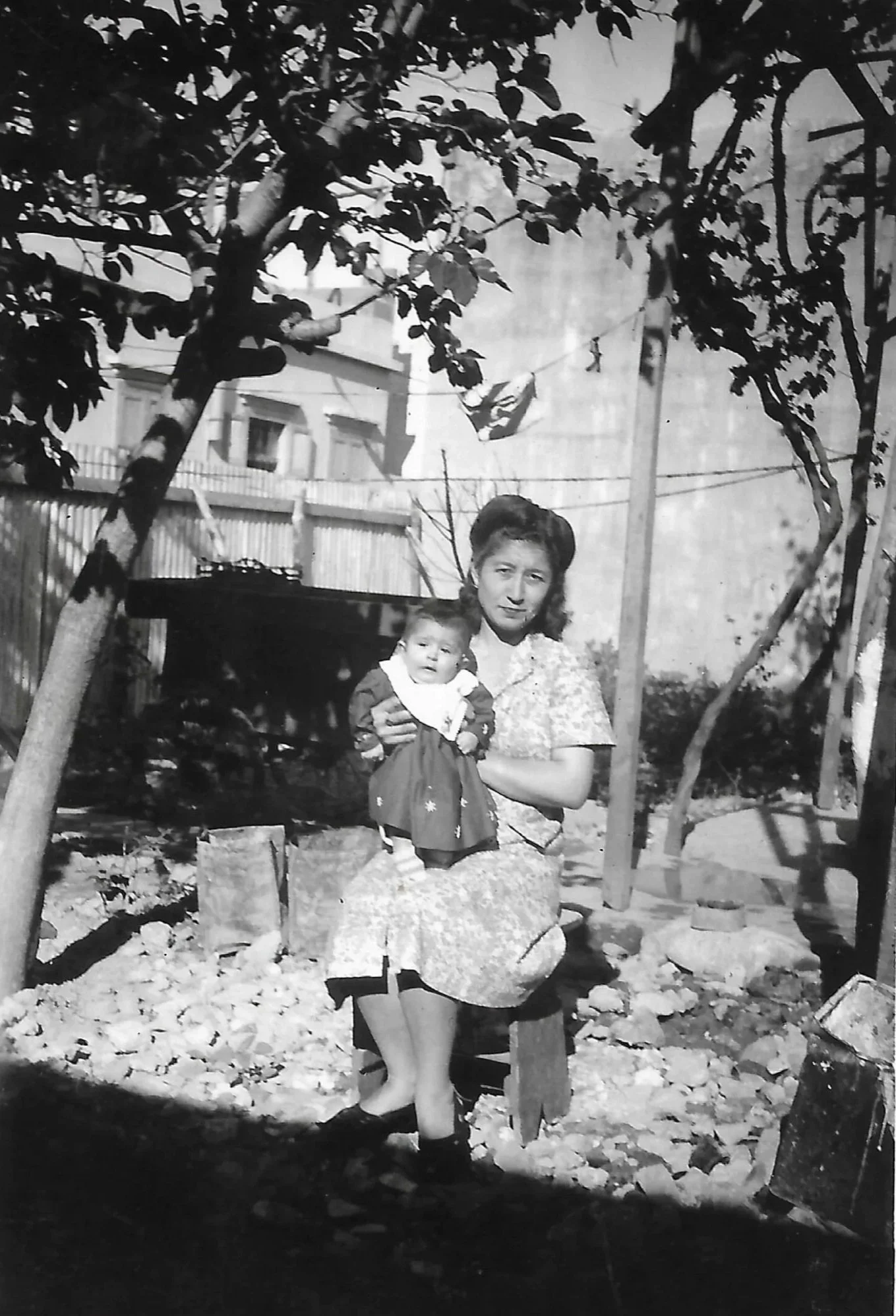
Elise Youssoufian's grandmother, Elise Matossian (née Dedeian), holding her then-two-month-old daughter, Elise Y.'s mother, Beirut, Lebanon, 1947. When Elise M. succumbed to cancer a decade later, her orphaned children—whose father had already passed away—were sent to Southern California to live with the older Armenian couples who adopted them, and who were themselves Genocide survivors. In her birthplace of Antioch (present-day Antakya, Türkiye), and in the Beirut neighborhood of Bourj Hammoud where the family found refuge, Elise Matossian was a highly regarded seamstress and embroiderer, especially sought after for intricate bridal garments and trousseau work. Photo: © Elise Youssoufian.
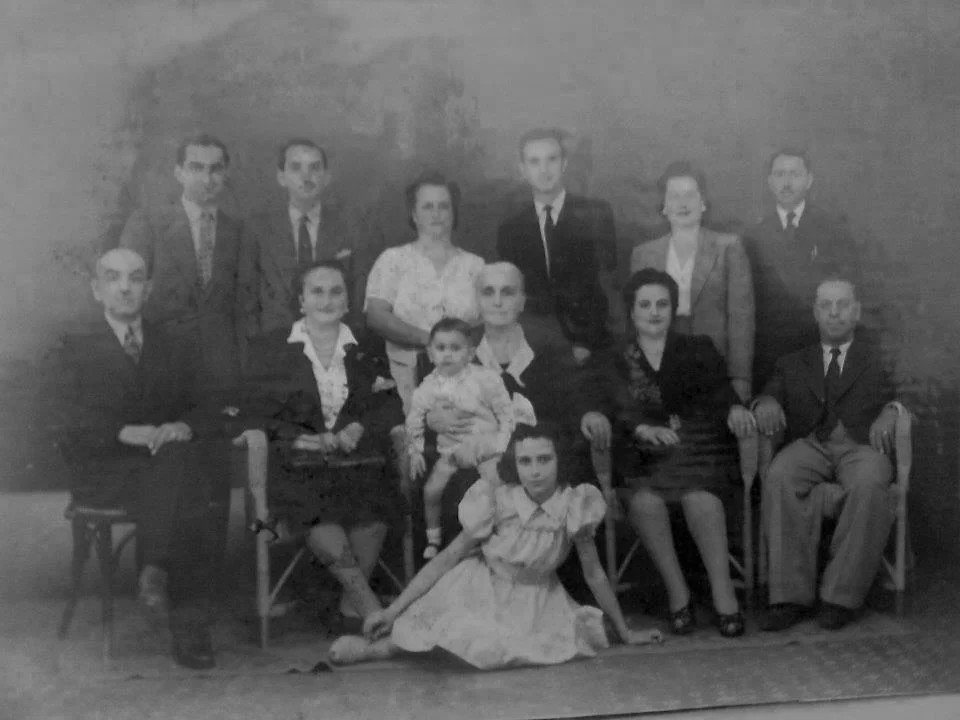
Elise Youssoufian's great-grandmother Arousiag Papazian (née Bodikian, center, holding Elise’s father as a child) surrounded by four of her five daughters (including Elise's grandmother Alice, back row, second from right), sons-in-law (including Elise's grandfather Ohannes Youssoufian, back row, far right), and grandchildren (including her eldest granddaughter, Aroussiac Shamlian, front, center), Cairo, ca. 1942. Greatly beloved, Arousiag passed away in mid-1950s Cairo with much of her family near, soon before they fled North Africa in the wake of hostilities toward non-Arab, non-Muslim citizens. Over time, all of Arousiag's relations—except Elise's grandparents—were able to reunite in Southern California. Arousiag, who survived genocide with her daughters intact, was known for her calm, philosophical mind, her green thumb, and her fine needlework. Photo: © Elise Youssoufian.
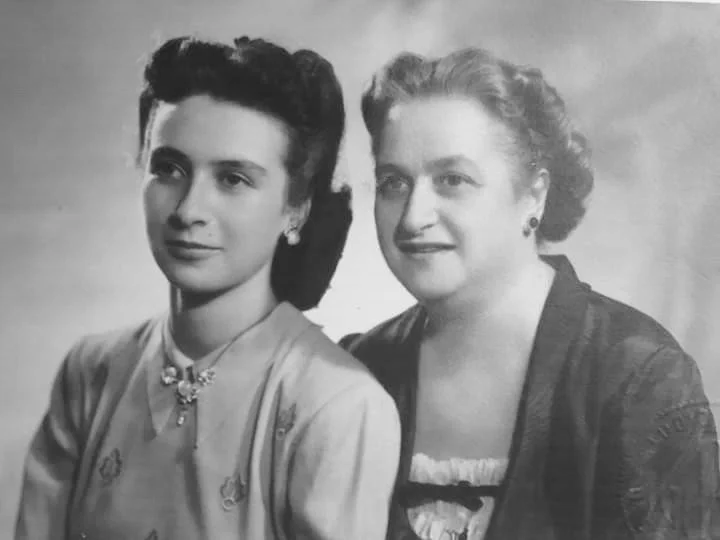
Elise Youssoufian's beloved կնքամայր (godmother), Aroussiac Bedrosian (née Shamlian), at the age of eighteen, with her mother, Zabel Shamlian (née Papazian), Cairo, 1949. This photo marks a pivotal moment in the Papazian family line, as mother and daughter knew they might be parted forever. Aroussiac bid farewell to her cherished mother, brother, grandmother, aunts, and cousins in Cairo when gifted an opportunity to visit relatives in Southern California who had found refuge there, post Genocide. During the visit, she fell in love with and married Thomas Bedrosian, with whom she built a vibrant family life and church community. In the mid 1950s, after her grandmother, Arousiag Papazian (Elise's great-grandmother), passed away in Cairo, Aroussiac was at last reunited with her mother, who relocated to Los Angeles and stayed by her daughter's side until the end of her days. Both were known for their warm hospitality and their artistry with needle and thread. Photo: © Bedrosian Family.
• back to the top •