deborah valoma
Տեպորահ Վալօմա
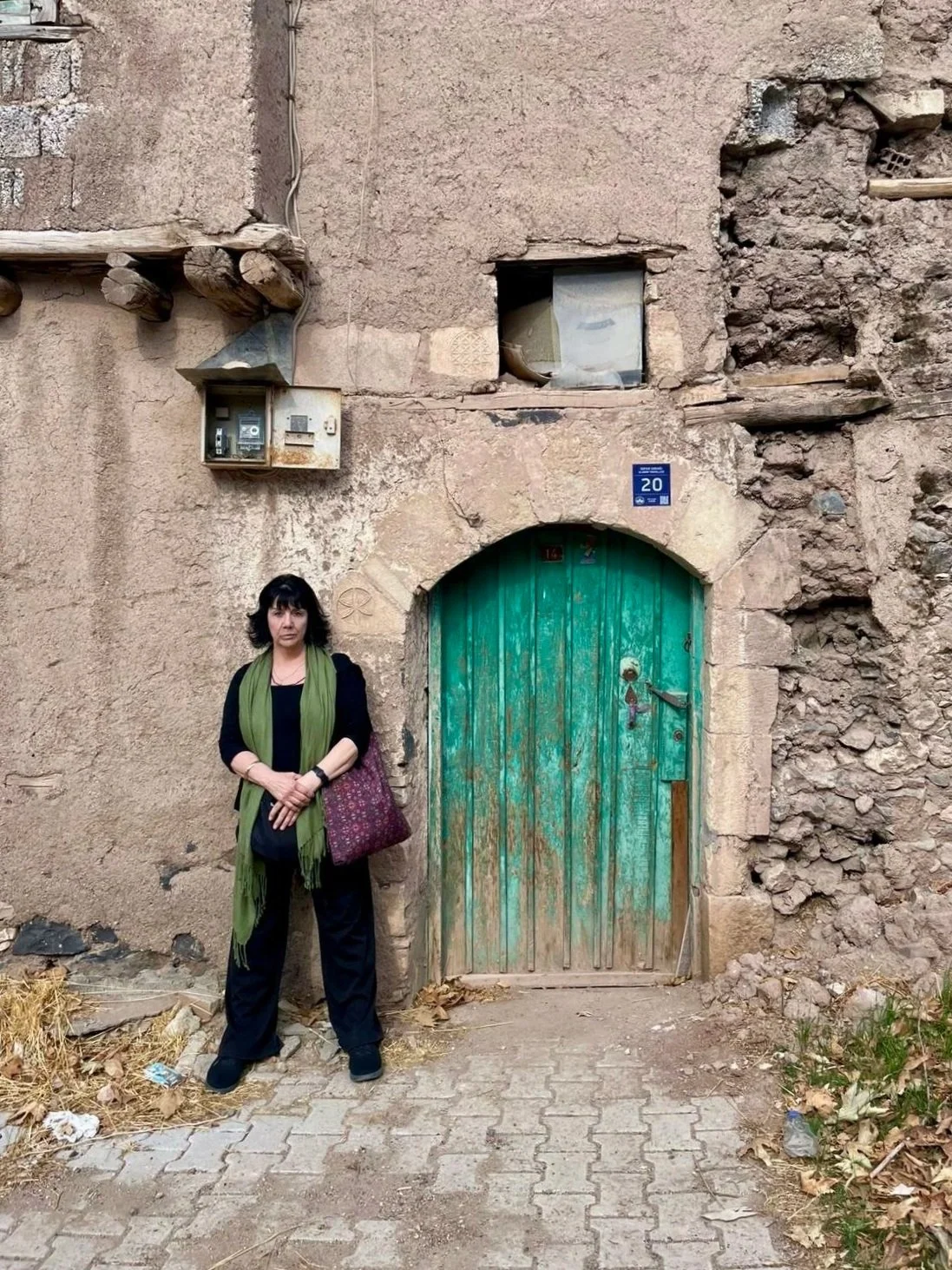
Deborah Valoma standing in front of a structure in Hussenig (present-day Ulukent), Türkiye, the ancestral village of her grandfather Hamparsoum Sohigian who emigrated to the United States in 1890. Photo credit: © Ezgi Kılınçaslan 2025.
teaching
Armenian Needlelace Initiative co-founder Deborah Valoma (she/her) is an artist, writer, professor emerita, and former Chair of the Textiles Program and Director of Fine Arts at California College of the Arts (CCA) in San Francisco. Her specialized field of research, writing, and teaching investigates textiles as signifiers of identity and agents of cultural continuity. With a Bachelor of Arts in Anthropology from the University of California, Berkeley (Summa Cum Laude) and Master of Fine Arts from the California College of Arts and Crafts (High Honors), her practice is a hybrid of theory and practice. Valoma’s professional training fuses academic scholarship and embodied knowledge in fields often populated by non-practitioners on the one hand and non-academics on the other.
During her twenty-eight years as a professor at CCA, Valoma developed a comprehensive series of graduate and undergraduate courses on textile history and theory, for which she earned a national reputation. These were taught through multiple lenses including colonialism and industrialism; cultural reclamation and indigenization movements; cultural appropriation and notions of so-called authenticity; and gendered and racialized hierarchies of aesthetic value in contemporary art. Textile history classes included: Constructing Identity: Textiles, Indigeneity, and Resistance; Women’s Work: Textiles, Gender, and Hierarchy; Textile Biographies: Trade, Hybridization, and Authenticity; Fashioning the Social Body: Appropriation and Cultural Cross-Dressing. Theory and practice seminars included: Thinking Textiles; Basket Case; Chromophilia; Craft Lab; Material Biographies; For-Site: Loss for Words.
scholarship
As a contributor to the growing body of textile scholarship, she has delivered lectures, curated exhibitions, and published writings on related topics. Early publications include “The Impermanent Made Permanent: Textiles, Pattern and the Migration of a Medium” (Fiberarts, 2005); “Cloth and African Identity in Bahia, Brazil” (Berg Encyclopedia of World Dress and Fashion, 2010); Lia Cook: In the Folds (Brown/Grotta, 2007); and “Complex Simplicity” (Kay Sekimachi: Simple Complexity, The Craft and Folk Art Museum, 2016). Deborah edited and wrote the introductory essay “Dust Chronicles” on the topic of dust and textile ephemerality for a special issue of the leading international peer-review publication Textiles: Journal of Cloth and Culture (2011).
In 2013 Deborah published the book Scrape the Willow Until It Sings, which traces the words and work of premier Native American elder and basketmaker Julia Parker (Heyday). A product of nine years of research, the book is part art volume, part oral history, and part historical analysis. Structured in four chapters, like the four quadrants of a basket, the book alternates between Deborah’s analysis and Parker’s storytelling. The book contextualizes Parker’s work as a carrier of intangible cultural heritage within the Native American cultural reclamation movement, but also positions her work within the contemporary art arena. More recent publications include: “When Linen Remembers,” a poetic treatise on the materiality of flax and linen (Material Intelligence, edited by Glenn Adamson, 2021); “Alluring Monotony+Luminous Threads,” an article addressing the rhythmic repetitions that run through weaving, dance, music, poetry, and prayer (Textile: Journal of Cloth and Culture, 2022); and “Following an Anonymous Thread,” an essay written in collaboration with Rehan Miskci about an heirloom photograph and cloak (Armenian Creatives, 2023).
Deborah is currently working on a multi-year, interdisciplinary project initiated when she inherited a collection of one hundred textile pieces from her grandmother Sara Sohigian Magarian and now officially held in the Sara Sohigian Magarian Archive. The most precious were crafted in Ottoman Anatolia and date back one-hundred-and-twenty years. A combination of archiving, researching, writing, and responsive art making, the project traces threadwork as an ancestral practice. Focusing primarily on Armenian needlelace, her research has taken her to Armenian population centers of Fresno, Los Angeles, Watertown, Jerusalem, Nazareth, and Istanbul to meet with contemporary Armenian needlelace practitioners. She wrote a review of the ground-breaking exhibition Janyak: Armenian Art of Knots and Loops curated by Gassia Armenian at the Fowler Museum at UCLA (Textile: Journal of Cloth and Culture, 2023) and the forthcoming essay “Thread Memory” to be published in both English and Turkish in the volume entitled 23:5 (Hrant Dink Foundation, Istanbul, 2026).
art making
Like her grandmother and great-grandmother, Deborah’s medium is thread. An experienced weaver, spinner, crocheter, basketmaker, and seamstress, she only began to practice Armenian needlelace in the last few years after learning the basic knot from her grandmother decades ago. Intensely research-based, her studio practice harnesses the nuances of this humble, yet poetically charged medium. Using hand construction techniques and cutting-edge digital weaving technology, Deborah’s work hugs the edges of traditional practice, simultaneously upholding age-old customs and unraveling long-held stereotypes. She has shown her work in various group exhibitions over the years and is represented by Brown/Grotta, but Deborah’s work has become more conceptual and ephemeral in nature over the last decade.
Currently engaged in a creative call-and-response with her Armenian foremothers, Deborah is crafting a body of work that re-remembers untold narratives and mends cultural through-lines. Hands-on art projects include a crocheted tablecloth narrating the story of her grandmother’s first cousin Satinig Chopoorian, who did not survive the genocide; a series of hand-woven linen shrouds commemorating those on her family tree marked as “died in massacres”; and a series of crocheted doilies duplicating pieces in her family collection as a means of communicating with her foremothers.
family
Three of Deborah’s four Armenian great-grandparents were survivors of the 1895 Hamidian Massacres in their home villages around Kharpert in Armenian Highlands in what is now Türkiye. In 1897 her great-grandmother Yeghsapet Ashodian (1871–1946) fled the Sinamoud district of Kharpert (no longer in existence) with her two surviving family members—her baby son and sister-in-law—to join her brother Baghdasar Ashodian in New York City, a weaver who had emigrated in 1884. A widow from the massacres, Yeghsapet married her second husband Garabed Magarian (1856–1921), also a widower from the early violence in his village of Hoghe (present-day Yurtbaşı). Yeghsapet gave birth to four more sons in Lowell, Massachusetts; the eldest was Deborah’s grandfather Masik Magarian (1898–1992). Deborah’s other great-grandmother, Margrit Varterestian (1878–1920), survived the massacres in Mezre (present-day Elazığ) and emigrated to Chicago in 1908, traveling with three children of her soon-to-be brother-in-law. She was wed in an arranged marriage to Hamparsoum Sohigian (1866–1937), who had emigrated earlier in 1890 from Hussenig (present-day Ulukent) to the Chicago area via Damascus, Alexandria, and Marseille. Margrit gave birth to four children; the eldest was Deborah’s grandmother Sara (1909–1993). Both families moved to the farm country of California in approximately 1910, where a growing community of Kharpertsi had settled in the Fresno Colony and found solace in growing grapes on the fertile land of the Central Valley.
On November 10, 2025, the 130th anniversary of the first day of the Hamidian Massacres in the Kharpert area, Deborah traveled to her ancestral villages of Sinamoud and Hussenig with close friends and colleagues Zeynep Taşkın and Ezgi Kılınçaslan. Deborah was the first in her Armenian lineage to set foot again on the land of her foremothers, and there, in the dry dust and tumbled stone she heard their whispers welcoming her home. On returning to Istanbul, she presented a lecture entitled “Following a Thread Home” at the Hrant Dink Foundation as a part of their ongoing series of lectures Ancestral Journeys: Reflections on Land and Belonging.
website
instagram
maker’s bio
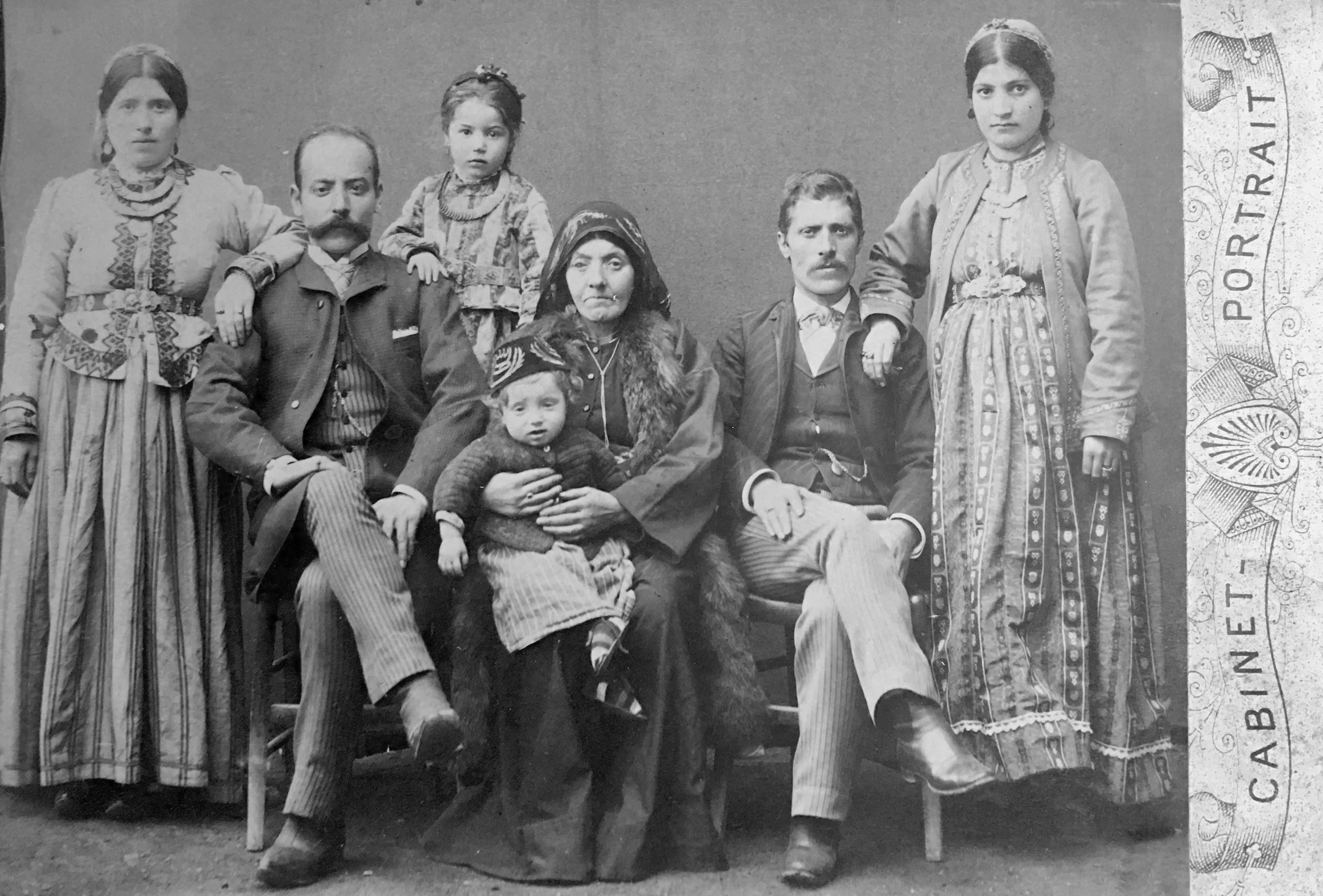
Ashodian Family from the Sinamoud district of Kharpert, ca. 1893. L to R, Deborah's great-grandmother Yeghsapet Ashodian, her first husband, daughter Manushak, mother Altoun, brother Baghdasar, and sister-in-law Yeghsapet. Her husband, daughter, and mother perished in the Hamidian Massacres (1894–1896). Photo: © Deborah Valoma.
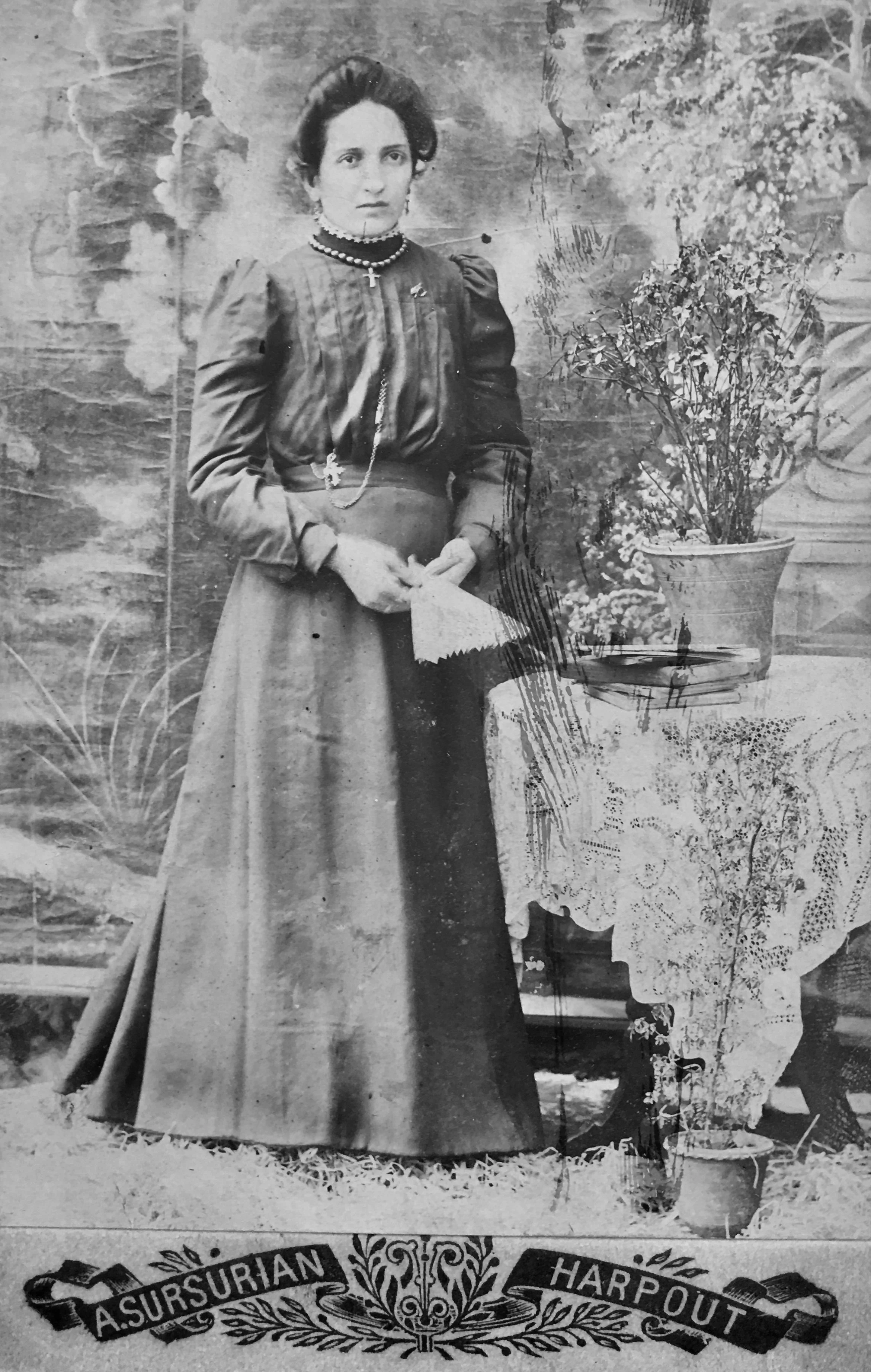
Margrit Varteresian, bride photograph taken before her arranged marriage to Hamparsoum Sohigian in the United States, photograph taken at the Sursurian Studios, Kharpert, ca. 1908. Her father, mother, and sister did not survive the Armenian Genocide (1915–1923). Photo: © Deborah Valoma.
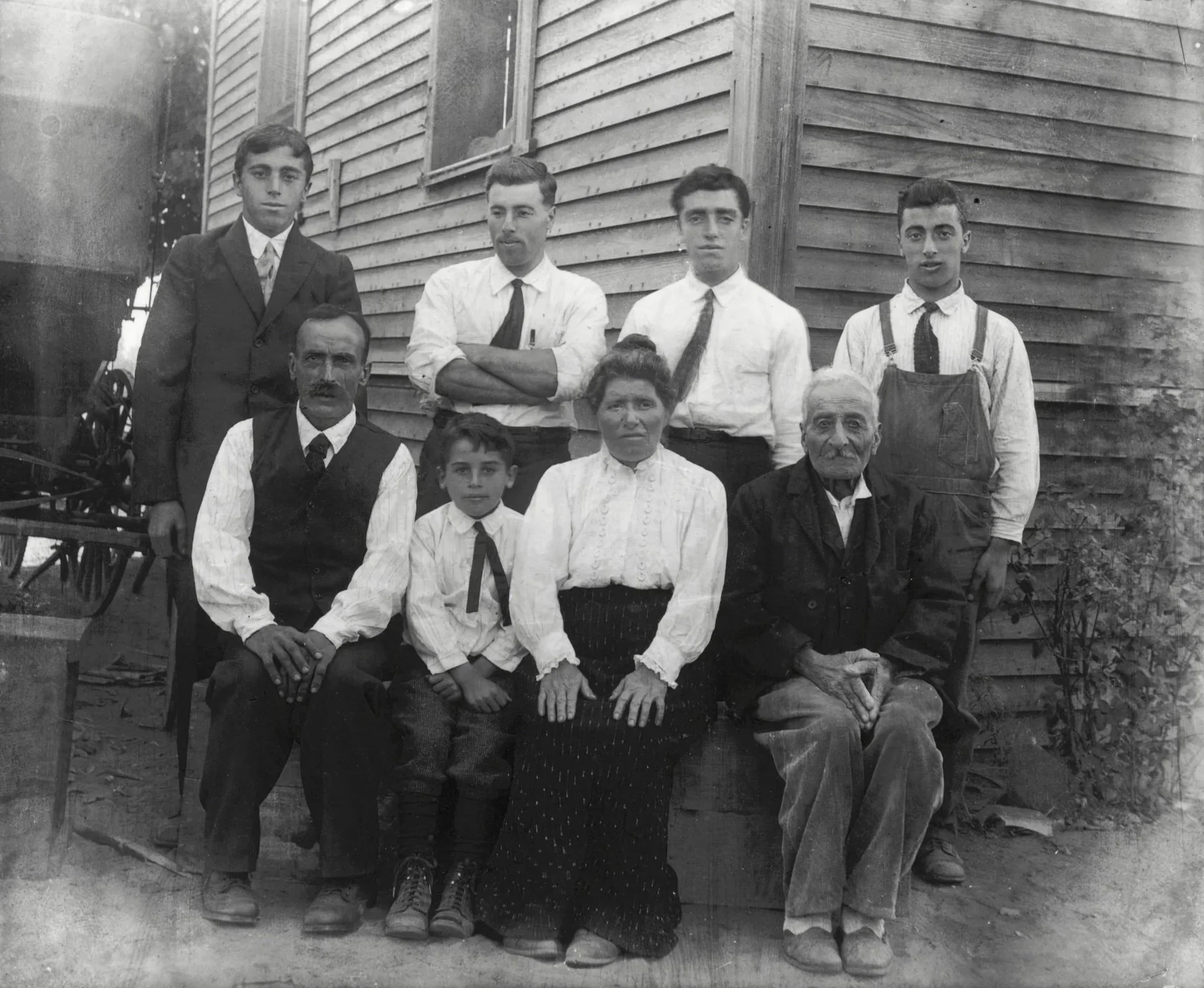
Magarian farm, Fresno Colony, California, ca. 1914. Yeghsapet Ashodian Magarian is seated in the center surrounded by her father (R), husband (L), and five sons. Deborah's grandfather Masick Magarian stands third from the left. Photo: © Deborah Valoma.
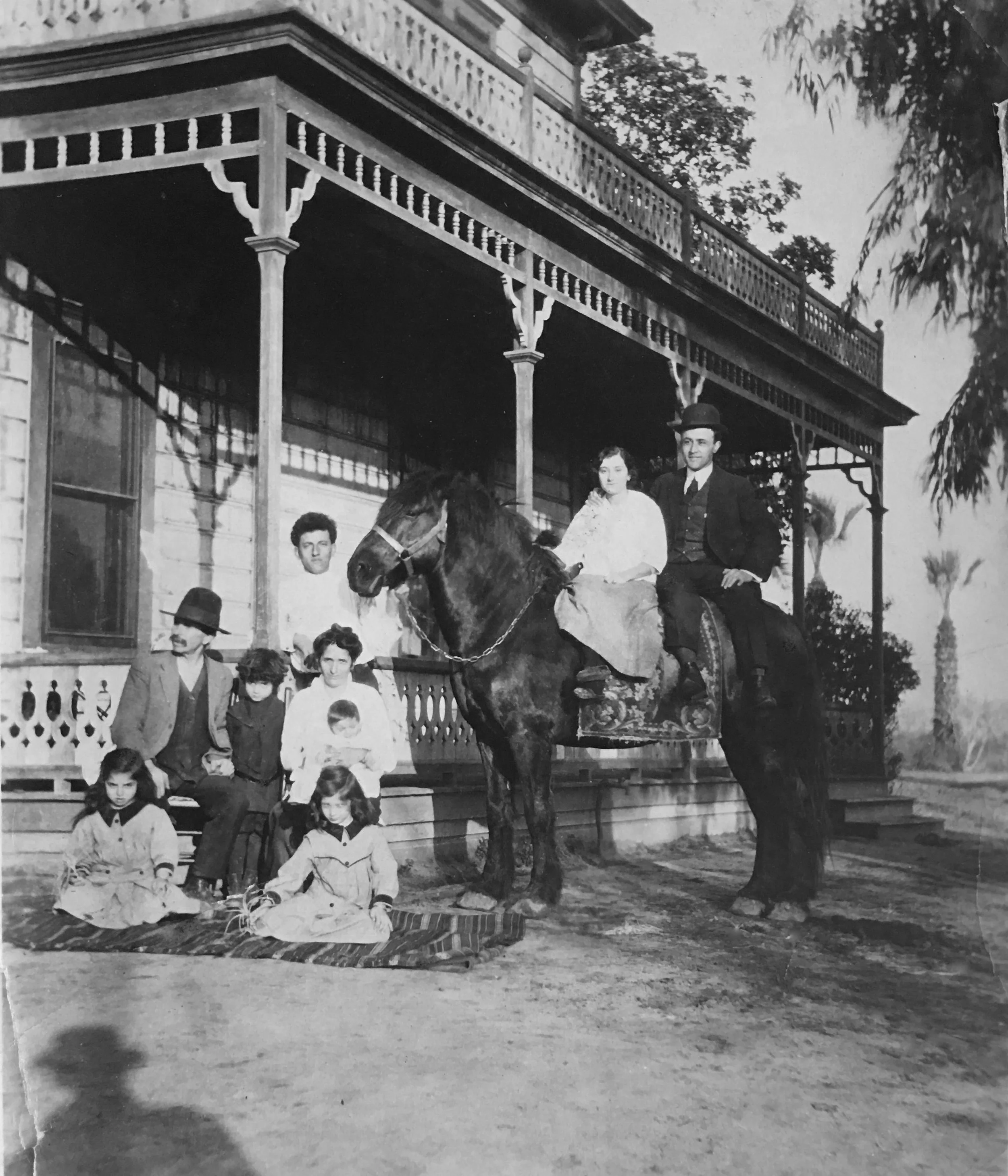
Sohigian farm, Fresno Colony, California, ca. 1915. Margrit Varteresian Sohigian is seated in the center, with her first-born daughter—Deborah's grandmother Sara—seated in front of her. Both were expert needleworkers, including needlelace. Photo: © Deborah Valoma.
• back to the top •