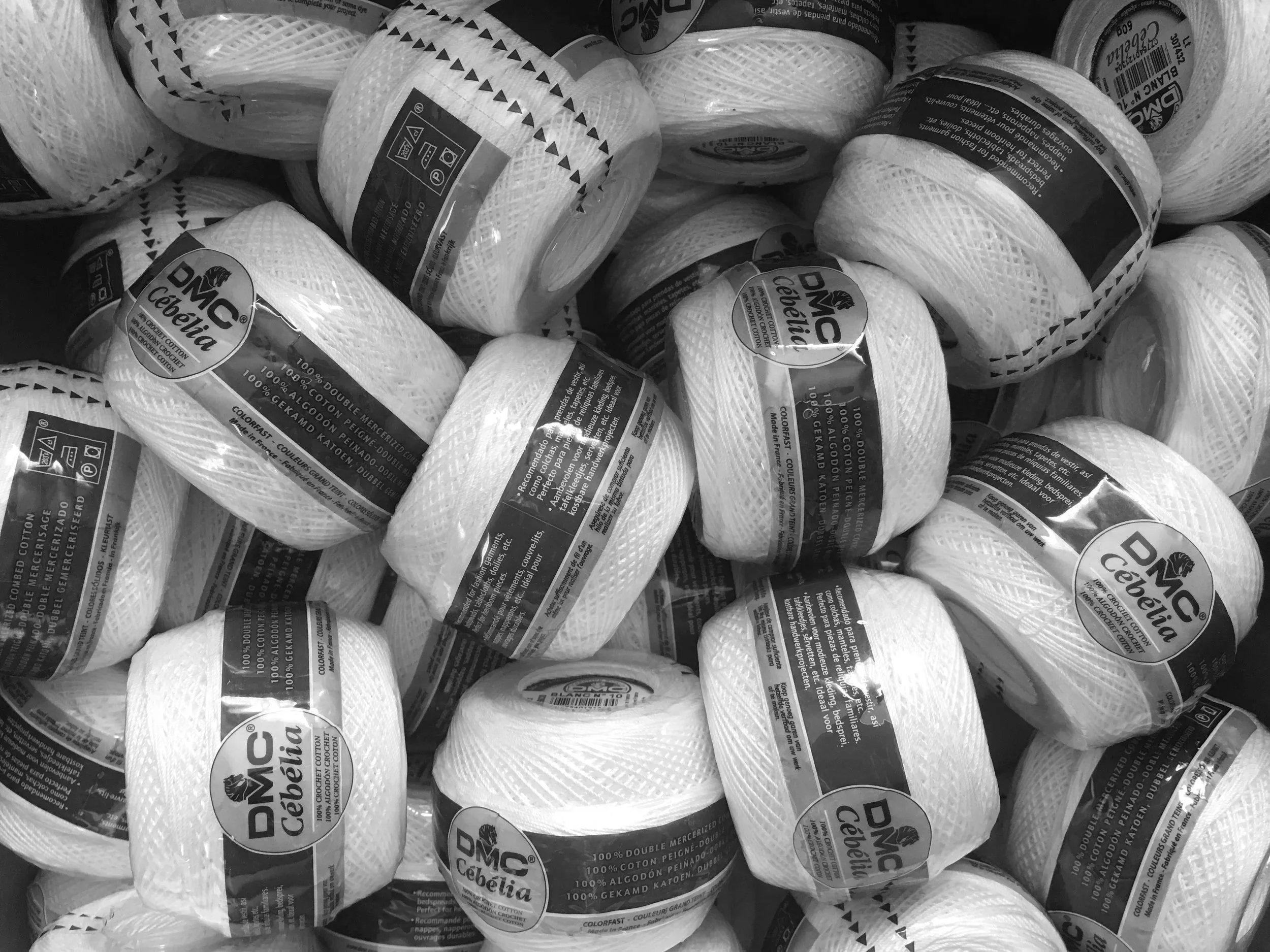
DMC Cébélia cotton thread. Photo credit: © Deborah Valoma 2018.
supplies
introduction
For beginning through advanced needlelace techniques and patterns, we recommend pairing strong, slender, and non-stretching thread with needles that have the smallest eye you can thread easefully. You may wish to experiment with several thread and needle sizes until you find the combination(s) that work best for you.
In general, threads that are tightly spun with a smooth surface and tensile strength are ideal for making knotted needlelace. Fine needlelace is often made with cotton cordonnet (six-ply), cebelia (three-ply), or perle cotton (two-ply) thread. Sometimes referred to as crochet or tatting thread, each type is available in a variety of colors and sizes from manufacturers and independent suppliers such as the ones linked below. Cordonnet and cebelia will generally result in clean look with clear thread lines; perle cotton, another good option, will typically result in a softer, slightly fuzzy appearance. For all three thread types, the higher the size number, the thinner the thread (e.g., size 40 is thinner than size 10).
For beginners, we suggest starting with:
Cordonnet or cebelia sizes 40 to 10 (i.e., thinner to thicker)
Perle cotton size 12 (equivalent to cordonnet size 40) or 8 (equivalent to cordonnet size 20)
Needles with a range of sizes, such as this set of Sashiko needles (made in Japan)
While linen and silk threads can be used, we do not recommend them—especially for beginners—as both tend to be more expensive than cotton. Additionally, linen and silk can be difficult to work with for different reasons. Linen threads tend to be somewhat sticky and have a natural twist that makes them a little stubborn, whereas silk threads tend to be slippery. Furthermore, silk is an animal product that harms silkworms and therefore raises ethical tensions. Also, be aware that the strength and stability of vintage threads tend to be compromised by age and thus we tend to avoid using them.
The thread guidance above notwithstanding, keep in mind that people always find a way to create using the materials they have access to. We encourage you to try your hand at making needlelace with less-than-ideal materials rather than not at all!
As you develop your needlelace practice, you may find yourself wondering how to care for your budding collection. Please refer to our Care page for advice on cleaning, photographing, storing, and documenting works of needlelace, be they antique or new.
recommended suppliers
• back to the top •