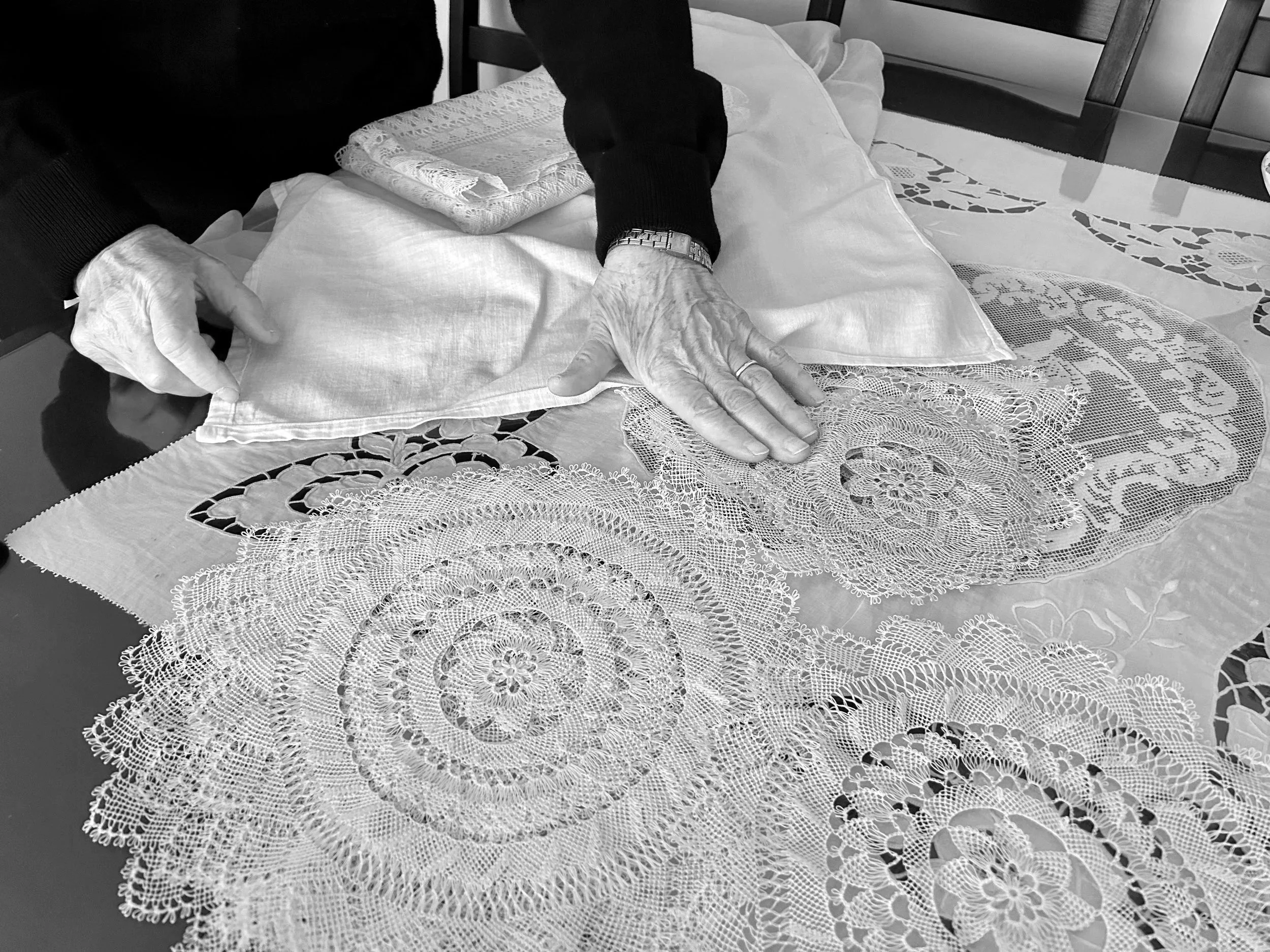
Expert needlelace maker Dzaghig Chitchi displaying her needlelace work, Şişli, Istanbul, Turkey, 2023. Photo credit: © Deborah Valoma 2023.
our mission
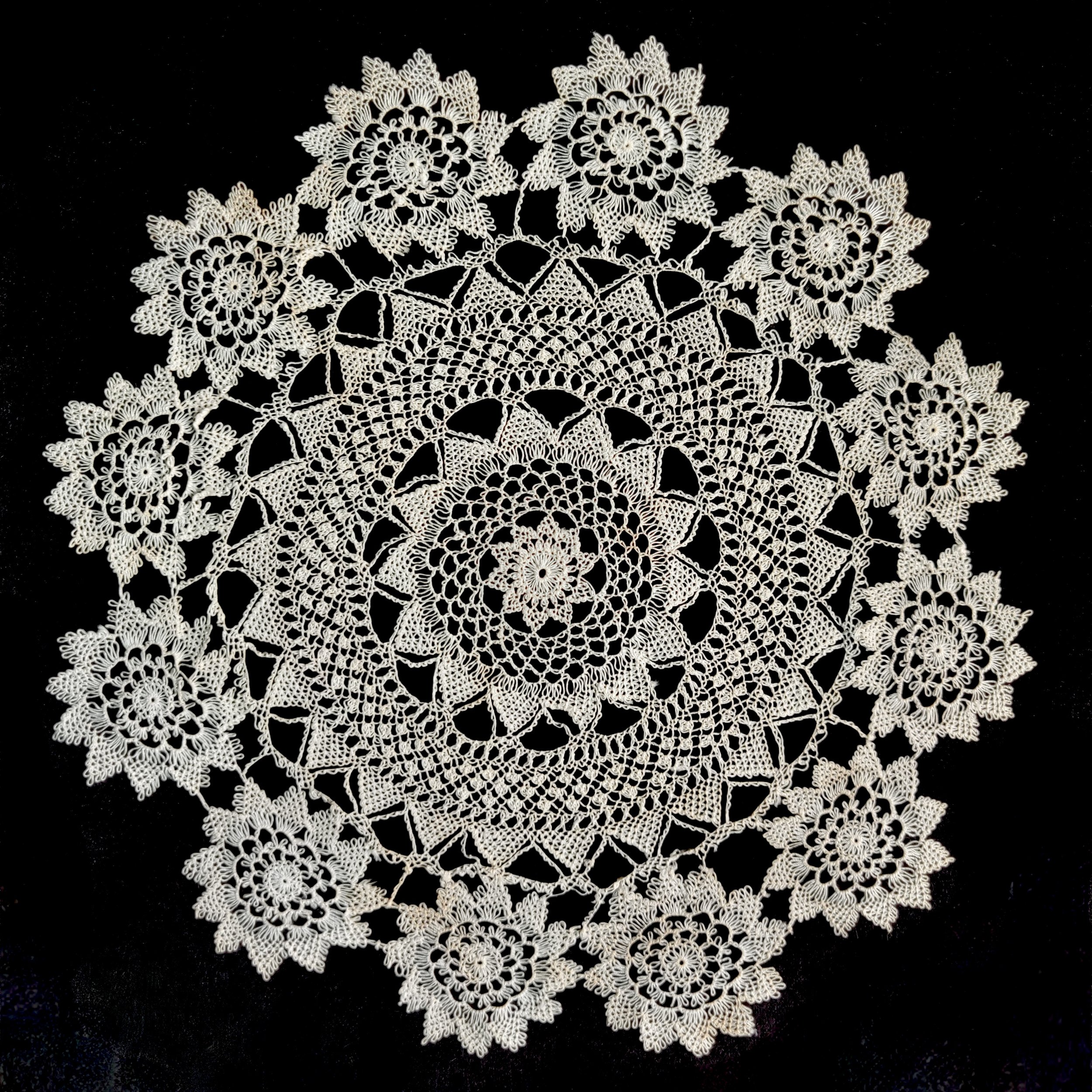
Armenian needlelace doily from the collection of Aroussiac Bedrosian (b. Kadıköy, Istanbul, 1936; d. Los Angeles, California, 2024), given to her goddaughter Elise Youssoufian by Aroussiac’s daughters after her passing. Photo credit: © Elise Youssoufian 2025.
Our mission at the Armenian Needlelace Initiative is to engage the global network of Armenian needlelace practitioners, researchers, curators, collectors, and enthusiasts. Our goal is to help revitalize interest in what some consider an antiquated artistic practice by encouraging learning and making, building a warehouse of resources, fostering communication and community across scattered populations, and providing a forum for storytelling and creative cultural exchange. While this site is not a platform for political debate, we acknowledge the rising patterns of domination and are committed to the role traditional crafts can play as acts of resistance in cross-pollinating sovereignty movements worldwide.
As descendants of genocide survivors, we are grateful that our families found refuge in California—Elise’s family on Tongva and Chumash territories (Los Angeles) and Deborah’s family on Yokut territories (Fresno). Elise and Deborah now live on the unceded land of the Lisjan (Ohlone) peoples, located on the eastern shores of the San Francisco Bay. Given our own histories of familial displacement, we feel the impact of our lineages on the land and Indigenous peoples and work toward being in right relationship.
our vision
According to UNESCO, an important strategy in safeguarding intangible cultural heritage is for “artisans to continue to produce craft and to pass their skills and knowledge onto others, particularly within their own communities.” For many, reviving textile traditions is an act of reclamation. And the intimacy of face-to-face communication and hand-to-hand transfer of skill yields relational and embodied experiences. In our dispersed communities, this is not always possible. We offer the Armenian Needlelace Initiative as an alternative, with profound gratitude for our ancestors, families, and homelands, and the countless kindred spirits—artists, activists, teachers, scholars, curators, culture bearers, and cultural organizations around the world, both Armenian and non-Armenian—whose work informs, expertise guides, and vision inspires.
Whatever our individual stories of dislocation and disorientation—exile from indigenous lands and severing of family ties, loss of language and unspoken histories of disaster, fragmented identity due to mixed bloodlines or discomfort with traditional gender roles—many of us have wished to feel welcomed as Armenians. Honoring Armenian needlelace is one way of seeking connection and reclaiming identity, of following the threads back to a sense of home. Like those safeguarding traditional Western Armenian language, folk songs, and dances, we share a deep longing to inhabit the patterns of our foremothers.
If you would like to support our mission, we gratefully accept donations of any size.
Deborah Valoma & Elise Youssoufian
Co-Founders, Armenian Needlelace Initiative
• back to the top •